Specifications
| Type | Description |
|---|---|
| Part Number | XL-304SYGC |
| Manufacturer | XINGLIGHT |
| Product Type | Through-Hole LED |
| Category | LED |
| Package / Case | F3 / 3.8 x 3.0 x 5.2 x 28 mm long-lead through-hole LED |
| Appearance Dimension | F3 / 3.8 x 3.0 x 5.2 x 28 mm; long lead type |
| Luminous Color | Yellow green; white/water colloid body |
| Colloid Color | White / water colloid; yellow-green LED |
| Moisture Sensitivity Level | MSL 2 |
| RoHS Compliance | Meets RoHS requirements |
| Power Dissipation | 70 mW; Ta=25°C absolute maximum rating |
| Maximum Continuous Forward Current | 20 mA; Ta=25°C absolute maximum rating |
| Peak Forward Current | 80 mA; Ta=25°C absolute maximum rating |
| Operating Ambient Temperature | -20°C to +85°C; absolute maximum rating |
| Storage Ambient Temperature | -40°C to +85°C; absolute maximum rating |
| Wave Soldering Temperature | 240°C for <=6 s; soldering point at least 2.0 mm from colloid bottom |
| Manual Welding Temperature | 300°C for 3 s; soldering point at least 2.0 mm from colloid bottom |
| Luminous Intensity | 50 to 300 mcd; IF=20 mA, Ta=25°C |
| Dominant Wavelength | 562 to 575 nm, typ 570 nm; IF=20 mA, Ta=25°C |
| Peak Wavelength | 570 nm typ; IF=20 mA, Ta=25°C |
| Forward Voltage | 1.8 to 2.6 V, typ 2.2 V; IF=20 mA, Ta=25°C |
| Viewing Angle | 30 deg typ; IF=20 mA, Ta=25°C, 2θ1/2 |
| Spectral Width at Half Height | 20 nm typ; IF=20 mA, Ta=25°C |
| Reverse Current | <=10 µA; VR=5 V, Ta=25°C |
| Datasheet Status | request_only |
Product Overview
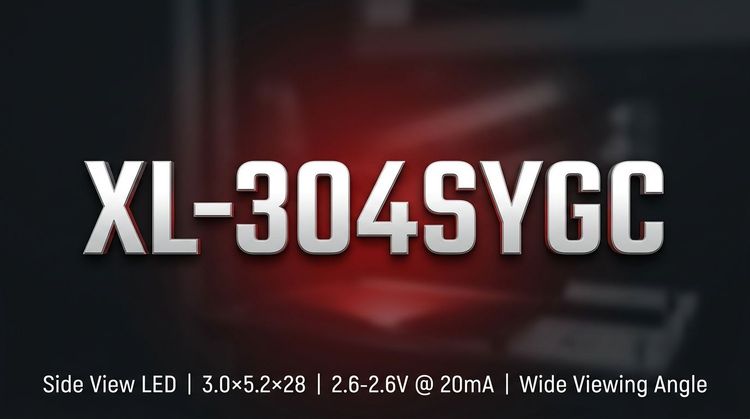
XL-304SYGC is a XINGLIGHT yellow-green through-hole LED supplied in an F3 long-lead package. The appearance dimension is specified as 3.8 x 3.0 x 5.2 x 28 mm, with a white/water colloid body and yellow-green luminous color. The package is intended for leaded mounting where lead forming and soldering controls are required.
At IF=20 mA and Ta=25°C, the LED is specified for 50 to 300 mcd luminous intensity, 562 to 575 nm dominant wavelength with 570 nm typical, 570 nm typical peak wavelength, and 1.8 to 2.6 V forward voltage with 2.2 V typical. The typical viewing angle is 30 degrees, and spectral width at half height is 20 nm typical.
Absolute maximum ratings include 70 mW power dissipation, 20 mA maximum continuous forward current, 80 mA peak forward current, -20°C to +85°C operation, and -40°C to +85°C storage. Assembly notes specify wave soldering at 240°C for up to 6 s and manual welding at 300°C for 3 s, with the soldering point at least 2.0 mm from the colloid bottom.
Key Features
- Yellow-green luminous color with white/water colloid body
- F3 long-lead through-hole package format
- 3.8 x 3.0 x 5.2 x 28 mm dimensions
- 50 to 300 mcd luminous intensity at 20 mA
- 562 to 575 nm dominant wavelength range
- 1.8 to 2.6 V forward voltage range
- 30 degree typical viewing angle at 20 mA
- 20 mA maximum continuous forward current
- MSL 2 declared moisture sensitivity level
- RoHS requirements met per datasheet statement
- Bags with moisture-proof anti-electrostatic foil packaging
- Lead bending at least 2 mm from colloid
Typical Applications
- Panel status indicators
- Yellow-green signal indicators
- Through-hole PCB indicators
- Equipment front-panel lamps
- Control board visual indicators
- Low-current indicator circuits
- Discrete LED assemblies
Procurement Notes
When requesting a quote for XL-304SYGC, buyers should confirm the manufacturer, package or case, required quantity, target date code, compliance documents, packing method, destination country and expected delivery schedule.
If alternatives are acceptable, buyers should share the approved vendor list, required electrical or optical limits, package constraints and qualification requirements. Any alternative part should be reviewed by the buyer's engineering team before production use.
For LED and optoelectronic sourcing, brightness bin, wavelength or color temperature bin, forward voltage range, viewing angle, moisture sensitivity level and soldering process limits may affect final selection, availability and lead time.
Alternatives
Candidate
EVERLIGHT
204-10SYGC/S530-E2-L
Candidate
TOGIALED
TJ-L3FYTGCKTCGLFLC7K-A5
These are candidate cross-reference options. Share quantity, application, approved vendor list, package limits and optical/electrical requirements before sample or quote review.
Request Sample / Quote ReviewApplication Verification Recommended
Related Technical Articles
FAQ
What type of LED is XL-304SYGC?
XL-304SYGC is a XINGLIGHT yellow-green through-hole LED. The datasheet identifies an F3 long-lead body with 3.8 x 3.0 x 5.2 x 28 mm appearance dimensions and a white/water colloid body.
What are the main optical specifications at 20 mA?
At IF=20 mA and Ta=25°C, XL-304SYGC is specified for 50 to 300 mcd luminous intensity, 562 to 575 nm dominant wavelength with 570 nm typical, 570 nm typical peak wavelength, and a 30 degree typical viewing angle.
What forward voltage range does XL-304SYGC use?
The forward voltage is specified as 1.8 to 2.6 V with 2.2 V typical at IF=20 mA and Ta=25°C. Datasheet voltage grades divide this range from N12-7 through N13-1.
What soldering limits are specified for this LED?
Wave soldering is specified at 240°C for up to 6 seconds, and manual welding is specified at 300°C for 3 seconds. In both cases, the soldering point must be at least 2.0 mm from the colloid bottom.
How should XL-304SYGC be stored and handled?
Recommended storage is temperature <=30°C and relative humidity <=70% in the original box for no more than 3 months. Packaging uses moisture-proof and anti-electrostatic foil bags, and ESD protection limits are HBM <1000 V and machine discharge mode <100 V.
Technical Review & Sourcing Note
Prepared by LDeepAI Component Sourcing Team. Reviewed for RFQ, documentation and alternative sourcing use. Last updated: July 28, 2026.
This page is based on manufacturer datasheet information and LDeepAI sourcing review. Specifications should be verified against the official manufacturer datasheet before final procurement or design approval. Final electrical, optical and reliability approval should be confirmed by the buyer's engineering team.