Specifications
| Type | Description |
|---|---|
| Part Number | XL-IRM1838D |
| Manufacturer | XINGLIGHT |
| Product Type | SMD LED |
| Category | LED |
| Component Type | Sensor |
| Package Case | Epoxy resin plastic encapsulated semi-circular spherical nose-bridge package, 7.3 x 6.9 x 3.7 mm body, 25 mm pin length |
| Supply Voltage Absolute Maximum | 6.0 V |
| Operating Ambient Temperature | -20°C to +85°C |
| Storage Ambient Temperature | -40°C to +125°C |
| Wave Soldering Condition | 240°C, <=6 s |
| Manual Welding Condition | 300°C, 3 s |
| Working Current | 0.3 min, 0.4 typ, 0.5 max mA |
| Receive Distance at 0 Degrees | 10 min, 15 typ m |
| Receive Distance at Left 35 Degrees | 5 min, 6 typ m |
| Receive Distance at Right 35 Degrees | 5 min, 6 typ m |
| Carrier Frequency | 37.9 kHz typ |
| BPF Width | 6 kHz typ |
| Low Level Output Voltage | 250 mV max |
| High Level Output Voltage | 4.5 min, 5.0 max V |
| Output Pulse Width Low | 400 min, 600 typ, 800 max us |
| Output Pulse Width High | 400 min, 640 typ, 800 max us |
| Minimum Pulse Width | 350 us min |
| Minimum Interval Time | 450 us min |
| Encoding Pause Time | 45 us min |
| Recommended Supply Voltage | 2.7 min, 5.5 max V |
| Recommended Input Frequency | 37.9 kHz typ |
| Recommended Operating Temperature | -20°C to +85°C |
| Receive Distance Grade L1 | 6 to 8 m |
| Receive Distance Grade L2 | 10 to 15 m |
| Receive Distance Grade L3 | 15 to 20 m |
| Working Voltage Grade V1 | 2.5 to 5.5 V |
| Working Voltage Grade V2 | 2.7 to 5.5 V |
| Working Current Grade I1 | 0.3 to 0.5 mA |
| Working Current Grade I2 | 0.4 to 0.7 mA |
| Output Logic Compatibility | TTL and CMOS compatible, active low output |
| Internal Optical Element | High-speed, high-sensitivity PIN photodiode with low-power high-gain preamplifier IC |
| Package Dimensions | 7.3 x 6.9 x 3.7 mm body, 25 mm pin length |
| Dimension Tolerance | ±0.25 mm |
| Storage Humidity | <=70% RH |
| Storage Temperature | <=30°C |
| Recommended Original Package Storage Duration | <=3 months |
| Cleaning Time with Ethanol | <=3 minutes |
| Lead Bend Distance from Body | >=2 mm |
| Electrostatic Human Body Model Limit | HBM <1000 V |
| Electrostatic Machine Model Limit | <100 V |
| Environmental Compliance | REACH and RoHS certified |
| Datasheet Status | request_only |
Product Overview
The XINGLIGHT XL-IRM1838D is an infrared remote control receiver classified in the LED category and described as a sensor. Its internal optical element combines a high-speed, high-sensitivity PIN photodiode with a low-power high-gain preamplifier IC, producing a TTL and CMOS compatible active-low output for remote-control signal reception.
The receiver is specified for a recommended supply voltage range of 2.7 to 5.5 V and a recommended input frequency of 37.9 kHz. At VDD=5 V and Ta=25°C, working current is 0.3 mA minimum, 0.4 mA typical, and 0.5 mA maximum. Receive distance is specified as 10 m minimum and 15 m typical at 0 degrees, with 5 m minimum and 6 m typical at left or right 35 degrees.
The package is an epoxy resin plastic encapsulated semi-circular spherical nose-bridge form with a 7.3 x 6.9 x 3.7 mm body and 25 mm pin length. Assembly-related limits include 240°C for up to 6 s wave soldering, 300°C for 3 s manual welding, and lead bending at least 2 mm from the body.
Key Features
- 37.9 kHz typical carrier frequency
- 2.7 to 5.5 V recommended supply range
- 0.4 mA typical working current at 5 V
- TTL and CMOS compatible active-low output
- 10 m minimum receive distance at 0 degrees
- 6 kHz typical band-pass filter width
- Integrated PIN photodiode and preamplifier IC
- -20°C to +85°C recommended operating temperature
- 250 mV maximum low-level output voltage
- REACH and RoHS certified product description
Typical Applications
- Infrared remote control receivers
- 37.9 kHz IR remote inputs
- TTL logic receiver interfaces
- CMOS logic receiver interfaces
- Active-low IR signal detection
- Low-current remote receiver circuits
Procurement Notes
When requesting a quote for XL-IRM1838D, buyers should confirm the manufacturer, package or case, required quantity, target date code, compliance documents, packing method, destination country and expected delivery schedule.
If alternatives are acceptable, buyers should share the approved vendor list, required electrical or optical limits, package constraints and qualification requirements. Any alternative part should be reviewed by the buyer's engineering team before production use.
For LED and optoelectronic sourcing, brightness bin, wavelength or color temperature bin, forward voltage range, viewing angle, moisture sensitivity level and soldering process limits may affect final selection, availability and lead time.
Related Technical Articles
XL-GK152 Through-Beam Sensor: Thermal & Signal Drift Analysis
The XINGLIGHT XL-GK152 is a 940nm through-beam photoelectric switch designed for high-reliability object detection in compact OEM circuits. This technical analysis evaluates cri...
XL-ITR20005 Transmissive Sensor: SMT Integration & Signal Consistency
The XL-ITR20005 from XINGLIGHT is a transmissive photoelectric switch designed for compact automation and consumer electronics, utilizing a 940nm infrared emitter and phototrans...
XL-IRM0038C IR Receiver: Evaluating 37.9kHz Immunity & SMT Integration
The XL-IRM0038C from XINGLIGHT is a LED designed for indicator and backlight applications. This technical guide helps design engineers and procurement teams evaluate the compone...
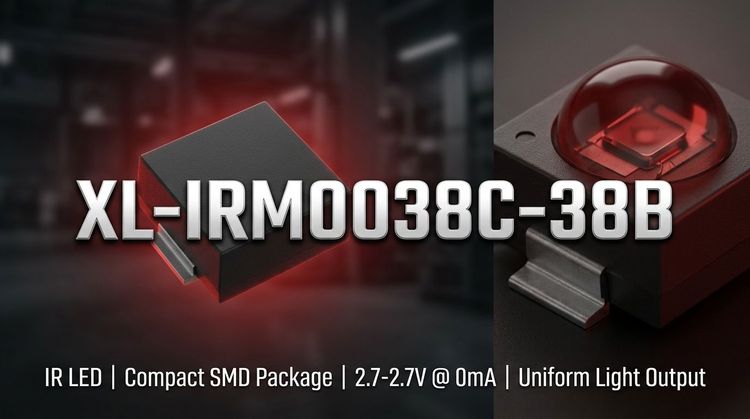
XL-IRM0038C-38B SMD LED — Technical Specifications & Design Guide
The XL-IRM0038C-38B from XINGLIGHT is a LED designed for indicator and backlight applications. This technical guide helps design engineers and procurement teams evaluate the com...
FAQ
What type of component is XL-IRM1838D?
XL-IRM1838D is an XINGLIGHT infrared remote control receiver sensor in the LED category. The datasheet describes it with a PIN photodiode and low-power high-gain preamplifier IC.
What supply voltage is recommended for XL-IRM1838D?
The recommended supply voltage is 2.7 V minimum to 5.5 V maximum. The absolute maximum supply voltage rating is 6.0 V at Ta=25°C.
What carrier frequency does XL-IRM1838D use?
The carrier frequency is specified as 37.9 kHz typical at Ta=25°C. The recommended input frequency is also listed as 37.9 kHz typical.
What package dimensions are specified for XL-IRM1838D?
The package body measures 7.3 x 6.9 x 3.7 mm, with a 25 mm pin length. Unless otherwise specified, the dimensional tolerance is ±0.25 mm.
What output logic does XL-IRM1838D provide?
The output is TTL and CMOS compatible with active-low logic. Low-level output voltage is 250 mV maximum at Isink=2.0 mA, and high-level output voltage is 4.5 V minimum to 5.0 V maximum at VCC=5 V.
Technical Review & Sourcing Note
Prepared by LDeepAI Component Sourcing Team. Reviewed for RFQ, documentation and alternative sourcing use. Last updated: June 30, 2026.
This page is based on manufacturer datasheet information and LDeepAI sourcing review. Specifications should be verified against the official manufacturer datasheet before final procurement or design approval. Final electrical, optical and reliability approval should be confirmed by the buyer's engineering team.