Specifications
| Type | Description |
|---|---|
| Part Number | XL-PD438B |
| Manufacturer | XINGLIGHT |
| Product Type | SMD LED |
| Category | LED |
| Outline Dimensions | 6.6 x 4.8 x 3.8 mm |
| Lens/Colloid Color | Black colloid |
| Moisture Sensitivity Level | MSL 3 |
| RoHS Compliance | Complies with RoHS Directive |
| Power Dissipation | 150 mW max |
| Reverse Voltage | 32 V max |
| Operating Ambient Temperature | -40°C to +85°C |
| Storage Ambient Temperature | -40°C to +85°C |
| Soldering Condition | 260°C max, <=6 s |
| Open-Circuit Voltage | 0.35 V typ; λP=940 nm, Ee=5 mW/cm², Ta=25°C |
| Short-Circuit Current | 18 μA typ; λP=940 nm, Ee=1 mW/cm², Ta=25°C |
| Reverse Light Current | 15 μA min, 25 μA typ; λP=940 nm, VR=5 V, Ee=1 mW/cm², Ta=25°C |
| Reverse Dark Current | 5 nA typ, 30 nA max; VR=10 V, Ee=0 mW/cm², Ta=25°C |
| Rise Time | 50 μs typ; VR=10 V, RL=1000 Ω, Ta=25°C |
| Fall Time | 50 μs typ; VR=10 V, RL=1000 Ω, Ta=25°C |
| Reverse Breakdown Voltage | 25 V min, 170 V typ; Ee=0 mW/cm², IR=100 μA, Ta=25°C |
| Total Capacitance | 6 pF typ; Ee=0 mW/cm², VR=5 V, f=1 MHz, Ta=25°C |
| Spectral Bandwidth Range | 840 nm min, 1000 nm max; λ0.5, Ta=25°C |
| Peak Sensitivity Wavelength | 940 nm typ; Ta=25°C |
| Reverse Light Current Rank BIN1 | 10.2 to 16.5 mA; Ee=1 mW/cm², VCE=5 V |
| Reverse Light Current Rank BIN2 | 13.5 to 22.0 mA; Ee=1 mW/cm², VCE=5 V |
| Reverse Light Current Rank BIN3 | 18.0 to 27.5 mA; Ee=1 mW/cm², VCE=5 V |
| Reverse Light Current Rank BIN4 | 22.5 to 33 mA; Ee=1 mW/cm², VCE=5 V |
| Outline Dimension Tolerance | ±0.30 mm |
| Recommended Maximum Wave Soldering Temperature | 240°C for 6 s |
| Recommended Wave Soldering Frequency | One pass |
| Manual Soldering Iron Temperature | <300°C within 3 seconds per terminal, soldering iron capacity <25 W |
| Storage Temperature Limit | <=30°C |
| Storage Humidity Limit | <=70% RH |
| Recommended Original Package Storage Time | <=3 months |
| Ethanol Cleaning Time | <=3 minutes |
| Lead Bend Distance From Colloid | >=2 mm |
| Datasheet Status | request_only |
Product Overview
Electrical ratings include 150 mW maximum power dissipation, 32 V maximum reverse voltage, and operating and storage ambient temperature ranges of -40°C to +85°C. At 940 nm and Ta=25°C, the device has 0.35 V typical open-circuit voltage, 18 μA typical short-circuit current, and 15 μA minimum to 25 μA typical reverse light current under the listed irradiance and bias conditions.
Dynamic and optical parameters include 50 μs typical rise time and 50 μs typical fall time at VR=10 V and RL=1000 Ω. The photodiode has 6 pF typical total capacitance, 25 V minimum and 170 V typical reverse breakdown voltage, an 840 nm to 1000 nm spectral bandwidth range, and 940 nm typical peak sensitivity wavelength.
Assembly guidance includes a 260°C maximum soldering condition for up to 6 seconds, a recommended wave soldering maximum of 240°C for 6 seconds with one pass, and manual soldering below 300°C within 3 seconds per terminal using a soldering iron below 25 W. Storage guidance specifies ≤30°C, ≤70% RH, and original-package use within 3 months.
Key Features
- Infrared receiver photodiode with black colloid package
- 6.6 x 4.8 x 3.8 mm outline dimensions
- 940 nm typical peak sensitivity wavelength
- 840 nm to 1000 nm spectral bandwidth range
- 150 mW maximum power dissipation rating
- 32 V maximum reverse voltage rating
- 50 μs typical rise and fall times
- 6 pF typical total capacitance at 1 MHz
- MSL 3 moisture sensitivity level
- Complies with RoHS Directive
Typical Applications
- Infrared receiver circuits
- 940 nm optical detection
- IR sensing assemblies
- Reverse-biased photodiode inputs
- Optical signal detection
- Ambient-rated receiver modules
Procurement Notes
When requesting a quote for XL-PD438B, buyers should confirm the manufacturer, package or case, required quantity, target date code, compliance documents, packing method, destination country and expected delivery schedule.
If alternatives are acceptable, buyers should share the approved vendor list, required electrical or optical limits, package constraints and qualification requirements. Any alternative part should be reviewed by the buyer's engineering team before production use.
For LED and optoelectronic sourcing, brightness bin, wavelength or color temperature bin, forward voltage range, viewing angle, moisture sensitivity level and soldering process limits may affect final selection, availability and lead time.
Related Technical Articles
FAQ
What type of device is XL-PD438B?
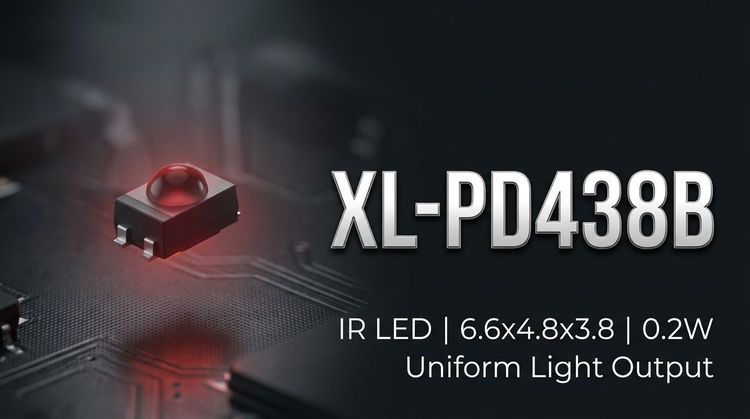
XL-PD438B is an XINGLIGHT infrared receiver photodiode in the LED category. The datasheet identifies a black colloid infrared receiver tube package with 6.6 x 4.8 x 3.8 mm outline dimensions.
What wavelength range does XL-PD438B support?
The datasheet lists a spectral bandwidth range from 840 nm minimum to 1000 nm maximum at Ta=25°C. The typical peak sensitivity wavelength is 940 nm.
What are the main soldering limits for XL-PD438B?
The maximum soldering condition is 260°C for no more than 6 seconds. The recommended wave soldering maximum is 240°C for 6 seconds with one pass, and manual soldering should stay below 300°C within 3 seconds per terminal.
Technical Review & Sourcing Note
Prepared by LDeepAI Component Sourcing Team. Reviewed for RFQ, documentation and alternative sourcing use. Last updated: July 28, 2026.
This page is based on manufacturer datasheet information and LDeepAI sourcing review. Specifications should be verified against the official manufacturer datasheet before final procurement or design approval. Final electrical, optical and reliability approval should be confirmed by the buyer's engineering team.