Key Takeaways
• The Event: Global DRAM and NAND prices are entering a new upcycle driven by AI infrastructure, not consumer electronics.
• The Cause: Automotive memory demand is rising structurally as vehicles adopt richer software, AI, and cockpit systems.
• The Implication: Vehicle pricing impact is limited, but supply predictability and lead-time risk are becoming strategic issues.
🚗 Opening
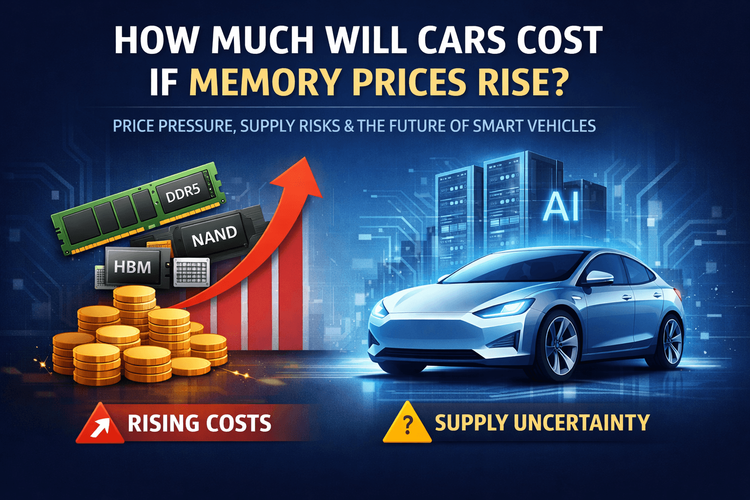
In early 2026, memory prices are rising across nearly all segments, from consumer DDR5 to automotive-grade DRAM, UFS storage, and enterprise-class NAND. A common assumption is that higher semiconductor prices will inevitably translate into more expensive cars. The more relevant question is not whether memory prices are increasing, but whether those increases are large enough to materially affect vehicle pricing—or whether they instead expose deeper risks in production stability and supply planning.
💡 What’s Changing
The current memory price upcycle differs structurally from past cycles. Demand growth is no longer led by PCs or smartphones, but by large-scale AI inference workloads. Modern AI systems consume vast amounts of DRAM for context windows, KV cache, and vector data structures, pulling capacity toward data centers where margins are higher and allocation is prioritized.
At the same time, vehicles—particularly EVs with advanced cockpits, ADAS, and on-device intelligence—are integrating far more memory than previous generations. What was once considered over-specification is quickly becoming baseline, driven by software-defined architectures and longer vehicle lifecycles.
📊 Data / Cost Comparison
Using conservative industry assumptions, DDR memory increasing from roughly USD 3 per GB to USD 6 per GB, and NAND or UFS storage from USD 0.3 per GB to USD 0.6 per GB, produces a noticeable but bounded impact.
For a typical smart EV equipped with 64–128 GB of DRAM and 128–256 GB of storage, total memory content often falls in the range of RMB 1,000 to 3,000. A 50 percent increase in memory pricing equates to approximately RMB 500 to 1,500 per vehicle. Even a full doubling results in RMB 1,000 to 3,000—material at the component level, but modest relative to a vehicle priced near RMB 200,000.
⚠️ Why Old Assumptions No Longer Work
Historically, automakers treated memory as a low-cost, low-risk component, assuming price volatility would be absorbed by tier-one suppliers. This assumption is weakening as memory content per vehicle grows faster than overall BOM expansion and as automotive competes directly with AI infrastructure for supply.
At the same time, the inverse assumption—that rising memory prices will sharply increase vehicle retail prices—is also misleading. Memory remains a small fraction of total vehicle value. The risk is not price shock, but constrained availability, longer lead times, and sudden allocation cuts during peak demand cycles.
📉 Implications for OEM / EMS / Procurement Teams
For OEMs and EMS partners, the primary exposure in 2026 is not MSRP pressure but production risk. Memory shortages or unpredictable lead times can stall assembly lines, force late-stage design compromises, or inflate buffer inventory costs.
Procurement teams face a shift from spot-price optimization toward long-horizon capacity assurance. BOM cost models that focus solely on unit price increasingly fail to capture the operational risk embedded in memory availability.
🚀 How Smart Teams Are Responding
More resilient organizations are reframing memory as part of the vehicle’s digital infrastructure rather than a passive commodity. This includes earlier engagement with suppliers, tighter coordination between software architecture and memory allocation, and more conservative assumptions around future availability.
Engineering teams are also scrutinizing how memory is distributed across infotainment, ADAS, and emerging on-device AI workloads. Inefficient memory usage no longer just affects performance—it directly increases exposure to supply disruption.
🔒 Closing
Rising memory prices will raise vehicle costs in 2026, but not enough to fundamentally alter pricing strategies or consumer demand. The real challenge is reliability of supply. As vehicles evolve into intelligent, software-defined systems, memory stability is emerging as a strategic constraint—one that OEMs and their partners can no longer afford to treat as an afterthought. Reaching alignment early on capacity and architecture is becoming a prerequisite for long-term resilience.