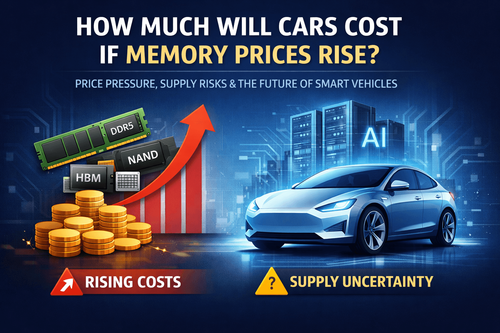
📊 Overview
The global semiconductor memory sector has officially transitioned from a buyer's market to a high-intensity seller's market. Recent reports from industry sources, including Korean media and Wccftech, confirm that Apple has agreed to a 100% price increase for LPDDR5X memory destined for the iPhone 17 series. This dramatic shift—doubling the previous price point—underscores the critical nature of current supply constraints rather than a mere fluctuation in commodity pricing.
For procurement professionals and engineering managers, this signals a fundamental change in sourcing strategy. The era of leveraging volume for aggressive pricing discounts is temporarily suspended. The immediate implication is a surge in Bill of Materials (BOM) costs for mobile devices and a need to reassess inventory holding strategies. The market is currently characterized by a "scarcity premium," where supply security outweighs cost efficiency.
✨ Key Insight: The acceptance of doubled pricing by Apple, historically known for its stringent cost control, is the leading indicator of a broader industry-wide supply crunch affecting all OEMs and EMS providers.
📈 Key Trends
The primary driver of the current pricing surge is a severe inventory depletion across the supply chain. According to disclosures made by SK Hynix during a recent virtual investor meeting with Goldman Sachs, the inventory levels of major memory manufacturers have dropped to approximately four weeks.
📉 Data Point: Current DRAM and NAND inventory levels are at critical lows (approx. 4 weeks), with SK Hynix stating that no customer demand is being fully satisfied.
This scarcity is driven by several technical and market dynamics:
- Production Discipline: Following a prolonged period of low profitability, memory manufacturers have maintained strict production discipline, keeping output aligned with actual demand rather than speculative capacity.
- Generational Shift: The industry is deep in the transition to LPDDR5X and upcoming LPDDR6. Fabrication capacity for older nodes is being converted or idled, tightening the supply of mature technologies still in high demand.
- AI and Mobile Convergence: High-bandwidth memory requirements for AI features in smartphones (like the iPhone 17) are consuming capacity that was previously allocated to standard mobile DRAM.
The negotiation details between Apple and Samsung DS reveal the intensity of this trend. Samsung initially targeted a 60% price increase but opened with a 100% figure to test the waters. Apple’s immediate acceptance of the higher price to lock in supply for the first half of the year illustrates the desperation among OEMs to secure allocation. This trend is not isolated to Apple; supply chain sources indicate that all major smartphone vendors are currently engaging in fierce bidding wars for memory allocation, driving spot prices and contract prices upward in unison.
🎯 Market Analysis
From a sourcing and risk management perspective, the current market conditions present a high-risk environment for product launches scheduled for late 2025 and 2026. The securing of supply by Apple highlights a fragmentation in the market where "Tier 1" customers are absorbing available capacity at premium rates, potentially squeezing smaller OEMs.
Supply Chain Constraints:
- DRAM: Apple has reportedly locked in DRAM supply only through the first half of 2026. This creates a significant uncertainty window for the latter half of the year.
- NAND Flash: The situation is even tighter for NAND, with Apple's confirmed supply extending only to Q1 2026.
👇 Sourcing Risk: The uncertainty surrounding NAND supply conditions beyond Q1 2026 poses a critical risk to BOM stability and product launch timelines for next-generation devices.
Market Forecast:
The shift in power to manufacturers (Samsung, SK Hynix, Micron) suggests that price elevation will persist. The market is no longer reacting to demand destruction but is constrained by physical supply limits. For procurement teams, this means that "Just-in-Time