China Chip Exports Soar 96%: Is Semiconductor Foreign Trade Really Becoming Easier?
Author/Source: Jiuru Xin News (Nine Ripples Chip News)
In the first half of 2026, China's semiconductor export sector delivered a remarkable performance that has caught the attention of the global electronics supply chain.
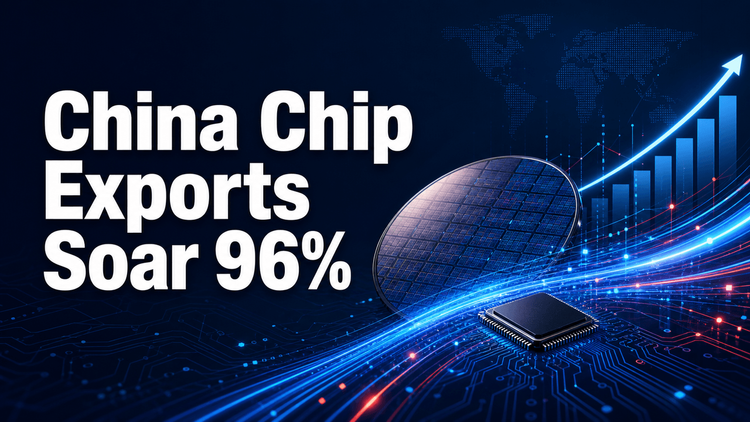
Customs data reveals that in the first half of this year, China's integrated circuit (IC) export revenue reached $177.28 billion USD, a year-on-year increase of 96.1%. Meanwhile, the total export volume reached 179.44 billion units, growing by approximately 6.9%.
We are seeing a massive discrepancy: one metric nearly doubled, while the other grew by less than 7%.
What does this divergence signify?
A granular analysis of the trade data reveals a critical shift in the industry's competitiveness. The average unit price (ASP) of China's exported chips has risen from approximately $0.54 USD in the same period last year to $0.99 USD—an appreciation of over 83%. The near-doubling of unit prices is far more significant than the modest volume growth.
This leads to a pivotal question for industry stakeholders: With export values skyrocketing, has the foreign trade environment for semiconductors truly become easier?
Why Did Value Double While Volume Remained Flat?
For the past several years, China's chip exports were characterized by a strategy of "high volume, thin margins." The export scale was largely supported by massive quantities of mature-node process chips, consumer electronics components, analog devices, and packaging and testing services. While the shipment numbers were staggering, the unit prices remained stubbornly low.
However, the most significant shift this year is not that we are selling significantly more, but rather that we are selling at significantly higher price points.
An average export price approaching $1.00 per chip might seem negligible on the surface, but when applied to a shipment scale of nearly 180 billion units, this represents a massive increment in value creation. Several structural factors are driving this transformation.
1. The Global Memory Market Re-entry into an Upcycle
The primary driver is the resurgence of the global memory semiconductor market. Since the beginning of this year, prices for DRAM and NAND Flash have been on a steady upward trajectory.
- High-Bandwidth Memory (HBM): The insatiable demand for AI training has led to a shortage in HBM and high-spec DDR5/LPDDR5, lifting the overall market pricing floor.
- Enterprise Storage: Enterprise-level SSDs are seeing robust recovery as cloud service providers (CSPs) resume capital expenditure.
- Commodities: Even common commodity products like standard DDR4, eMMC, and UFS storage have seen distinct price rebounds.
China is a massive participant in the global memory supply chain (including major foundries and packaging plants). As global ASPs for memory rise, the export value naturally surges in tandem.
2. The AI Industrial Chain Spillover Effect
While the cutting-edge GPUs and high-end AI processors remain dominated by a select few international giants, the AI infrastructure buildout is not limited to compute chips. An AI server is a complex system requiring a diverse ecosystem of components.
A single AI server, in addition to its GPUs or TPUs, requires a vast array of supporting semiconductors and passive components:
- Power Management: VRMs (Voltage Regulator Modules), DrMOS, Multi-phase Controllers, and Protection ICs.
- Signal Integrity: High-speed Clock Generators, Redrivers, Retimers, and PHY chips.
- Interconnect: High-speed interface chips (PCIe Switches), Ethernet PHYs, and serializers/deserializers (SerDes).
- Control & Memory: MCUs for board management, EEPROMs for firmware storage, and standard logic.
- Physical Infrastructure: PCBs (Printed Circuit Boards), advanced substrates, connectors, and passive components (capacitors, inductors).
As AI investment heats up, the entire upstream and downstream supply chain benefits. Chinese companies are aggressively expanding their export market share in these essential "sandwich" layers of the AI server stack.
3. Sustained Growth in Assembly and Test (OSAT)
China remains one of the world's largest bases for semiconductor Assembly and Testing (OSAT). Many international IDMs (Integrated Device Manufacturers) and fabless companies dispatch wafers to China for packaging and testing before re-exporting the finished goods to global markets.
Under statistical customs conventions (and depending on the specific trade model, such as ODM or OEM), these finished goods contribute significantly to the export revenue. As the content of chips becomes more complex (requiring more advanced packaging like SiP, CoWoS, or 2.5D/3D packaging), the value added by the packaging and testing stage increases, thereby lifting the total export value.
Export Growth Does Not Mean Trade is Becoming Easier
It is crucial to recognize that behind the impressive $177.28 billion figure, not every enterprise is enjoying the dividends of this growth. The surge in export value is largely driven by structural factors—memory price increases, AI demand expansion, and product mix upgrades—rather than a simple across-the-board increase in shipment volume.
For many chip manufacturers, the order structure is bifurcating:
- Booming Segments: AI servers, data centers, high-end industrial control, EVs (Electric Vehicles), and energy storage sectors maintain strong demand.
- Saturated Segments: Traditional consumer electronics (smartphones, PCs), general-purpose MCUs, and low-end analog chips face fierce competition. The price war in these mature markets has not fully abated; capacity utilization remains a pressure point.
Furthermore, the macro-environment is fraught with uncertainty:
- Trade Policy: Fluctuations in tariff policies and changes in export control lists create unpredictability.
- Compliance: Origin certification and supply chain traceability requirements are becoming stricter.
- Customer Strategy: Overseas clients are accelerating "China Plus One" strategies, diversifying their supply chains to mitigate risk.
Consequently, beautiful export data does not imply that the chip foreign trade sector has entered a "golden age" where profits are effortless. The challenges remain intense for those unable to climb the value chain.
Where Are the Opportunities for Chip Distributors and Traders?
Compared to manufacturers, this dataset offers even more critical signals for chip distributors and traders.
1. The Era of Simple Arbitrage is Ending
The model of relying solely on "flipping" goods for price differences is becoming increasingly difficult to sustain. As market information becomes more transparent and spot markets flatten, customers no longer compete solely on who can source the goods.
The new competitive moat is Supply Chain Integration:
- Speed: Who can deliver faster?
- Stability: Who can guarantee supply continuity during shortages?
- Application Knowledge: Who understands the customer's specific solution?
For distributors, the ability to integrate supply chain resources is gradually replacing simple price advantage as the barrier to entry.
2. AI is Reshaping the Product Demand Structure
Everyone is focusing on Nvidia GPUs and HBM memory, but the real, accessible opportunities often lie in the supporting components.
An AI server requires:
- Memory: Large quantities of DDR5, LPDDR5, and SSDs.
- Power: extensive arrays of Power Management ICs (PMICs), DC-DC converters, and MOSFETs.
- Connectivity: High-speed interconnects and retimers.
- Passives: High-end capacitors and resistors capable of handling high voltages and frequencies.
While the unit value of these components is far lower than a GPU, they constitute a massive procurement volume. This is a new market entry point for many traders.
3. Domestic Substitution is an International Theme
"Import substitution" is no longer just a domestic China strategy; it is becoming an export opportunity. An increasing number of overseas clients are beginning to qualify and accept Chinese brands.
- Product Categories: Domestic storage, MCUs, analog chips, power devices, and PMICs are entering international supply chains.
- Strategy: For traders familiar with overseas markets, rather than exclusively representing international brands, there is immense value in proactively laying out high-quality domestic brands. Finding new growth space in the export market by introducing "China Tech" to global OEMs is a viable strategy.
4. Selling Solutions, Not Just Chips
Future customers are not just purchasing components; they are procuring a comprehensive supply chain solution. The added value that determines long-term cooperation includes:
- Inventory Management: VMI (Vendor Managed Inventory) and buffer stock.
- Logistics: Bonded warehousing and speedy global delivery.
- Technical Support: Reference designs and pin-to-pin compatibility guidance.
- BOM Optimization: Cost-reduction engineering and lifecycle management.
The ability to provide these "soft services" combined with hardware is the key to winning high-margin business.
Conclusion
$177.28 billion USD and 96.1% year-on-year growth—this is undoubtedly a heartening report card.
However, for the semiconductor industry, the focus should not be solely on the growth figure itself, but on the profound structural shift in the export composition. China is no longer just exporting "quantity"; it is increasingly exporting high value-added products and sophisticated industrial chain capabilities.
- For Manufacturers: This represents an opportunity arising from product upgrades and technological maturation.
- For Distributors and Traders: It signals a change in competitive logic.
In the future, the competition will not merely be about "having stock." It will be about who can respond faster to global demands, integrate superior supply chain resources, and provide complete, turnkey solutions.
As sectors like AI, automotive electronics, renewable energy, and industrial automation continue to release demand, the semiconductor foreign trade market still possesses vast potential. However, those destined to share in this round of growth dividends will not be the traders relying merely on information asymmetry or price arbitrage. They will be the professional distributors capable of connecting upstream and downstream resources and possessing global supply chain operations and technical service capabilities.
Record-high export values are just the beginning. For the entire chip circulation industry, a new round of competition has only just begun to unfold.