Inside China’s Electronic Component Supply Chain: How Distribution Networks Really Work
🔑 Key Takeaways
• The Event: China’s electronic component market has developed a multi-layer supply ecosystem beyond the traditional manufacturer-to-distributor model.
• The Cause: Authorized distributors, independent suppliers and digital marketplaces evolved because OEMs require different solutions for volume purchasing, shortage recovery, prototyping and lifecycle management.
• The Implication: Understanding how these channels interact helps global engineering and procurement teams better evaluate supply availability, traceability and sourcing risks.
🚀 Opening
Electronic components rarely travel directly from semiconductor manufacturers to final OEM products.
Between wafer suppliers and production lines, there is a complex ecosystem involving authorized distributors, independent inventory networks, regional suppliers and digital platforms.
To overseas buyers, these channels may look similar — all appear to “sell components.”
However, each channel operates under a completely different logic.
Understanding this ecosystem is essential for companies sourcing components from China, especially when dealing with shortages, EOL products, prototype requirements or urgent production recovery.
🌏 What’s Changing: From Single-Channel Distribution to Multi-Layer Supply Networks
Traditionally, the semiconductor supply chain followed a relatively simple structure:
Component Manufacturer
↓
Authorized Distributor
↓
OEM / EMS Customer
Authorized distributors played the central role by providing:
- Manufacturer-approved supply channels
- Technical support
- Logistics services
- Inventory management
- Commercial agreements
However, several market changes have reshaped the ecosystem:
- Semiconductor supply shortages increased demand for alternative sourcing channels.
- Product lifecycles became shorter, creating more EOL and excess inventory.
- Global OEMs started requiring faster prototype and small-volume sourcing.
- Online platforms improved component search efficiency and price visibility.
As a result, China developed a highly connected supply network combining:
- Authorized distribution channels
- Independent inventory suppliers
- Electronic component marketplaces
These channels compete in some areas but support each other in others.
🏢 Authorized Distributors: The Manufacturer-Connected Channel
Authorized distributors represent the formal connection between semiconductor manufacturers and customers.
Their primary value is not only component supply.
They provide confidence through:
- Official manufacturer relationships
- Documented supply channels
- Technical support from FAE teams
- Long-term supply planning
For large OEM and EMS customers, authorized distribution remains the preferred route for:
- High-volume production
- Automotive and industrial applications
- Products requiring strict compliance documentation
💡 How Authorized Distribution Creates Value
Many people assume distributors simply buy components and resell them.
In reality, their business model includes multiple layers:
1. Manufacturer Relationship
Distributors invest heavily in maintaining relationships with semiconductor vendors.
These relationships provide:
- Product access
- Forecast coordination
- Technical communication
- Regional market support
For component manufacturers, distributors extend sales coverage without requiring direct support for every customer.
2. Technical Enablement
A major difference between authorized distributors and other channels is engineering support.
Many authorized channels provide:
- Reference design assistance
- Component selection guidance
- Application engineering support
- Design-in support
For complex IC products, technical capability can be as important as price.
3. Supply Chain Infrastructure
Large distributors operate:
- Regional warehouses
- Quality management systems
- Logistics networks
- Inventory planning systems
This infrastructure reduces friction for global production programs.
🔄 Independent Component Suppliers: The Flexible Market Layer
Independent suppliers play a different role.
They are not primarily built around manufacturer authorization.
Instead, their strength comes from:
- Inventory visibility
- Market information
- Supplier relationships
- Fast response capability
In China, independent supply networks developed because the electronics industry requires flexibility beyond formal distribution channels.
They often support situations such as:
- Urgent production shortages
- Obsolete component sourcing
- Small-volume requirements
- Factory excess inventory recovery
📦 Four Common Types of Independent Supply Models
1. Inventory-Based Suppliers
Some suppliers specialize in holding inventory based on market expectations.
They monitor:
- Manufacturer capacity changes
- Product lifecycle announcements
- Demand fluctuations
When shortages occur, available inventory can become strategically valuable.
However, inventory positioning also carries risk.
If supply conditions recover quickly, high-cost inventory may lose value.
2. Channel-Based Suppliers
Many professional suppliers focus on long-term relationships rather than market speculation.
Their sources may include:
- Factory excess inventory
- Distributor surplus
- EMS inventory transfers
- Overseas inventory movement
Their competitive advantage is information:
Knowing who has inventory, where it is located, and how quickly it can move.
3. EOL and Excess Inventory Specialists
Electronic manufacturing creates large amounts of excess inventory:
- Product transitions
- Design changes
- Project cancellations
- Lifecycle termination
Specialized suppliers help redistribute these components.
However, this area requires strong verification capability.
Professional buyers should evaluate:
- Packaging condition
- Date code consistency
- Lot information
- Label integrity
- Traceability documentation
The challenge is not only finding inventory.
It is confirming that inventory history is reliable.
4. BOM Fulfillment Networks
Some suppliers operate as component sourcing coordinators.
Instead of owning every item, they connect multiple inventory sources.
Their value comes from:
- Supplier network depth
- Market knowledge
- Fast matching capability
This model is especially common in prototype builds and urgent engineering projects.
🏙️ Shenzhen’s Role: China’s Component Information Hub
Any discussion of China’s component ecosystem must include Shenzhen.
Areas such as Huaqiangbei became internationally known because of their dense electronics network.
The ecosystem combines:
- Component trading companies
- Engineering service providers
- PCB manufacturers
- Repair and testing specialists
- Independent inventory suppliers
The unique characteristic is not only physical inventory.
It is information speed.
A component shortage can trigger rapid communication across thousands of suppliers through established business networks.
This information flow remains one reason Shenzhen continues to play an important role in global electronics sourcing.
🖥️ Electronic Marketplaces: Bringing Transparency to Component Search
Electronic component marketplaces changed how engineers discover and purchase components.
Before digital platforms, engineers often needed to:
- Contact multiple suppliers
- Compare different quotations
- Manually confirm availability
Online platforms introduced:
- Search by part number
- Stock visibility
- Specification comparison
- Online purchasing
This significantly improved efficiency for:
- Prototype development
- Small engineering teams
- Low-volume requirements
⚖️ The Limits of Digital Platforms
Despite their advantages, online marketplaces do not replace every traditional channel.
Their strengths are mainly:
- Standard components
- Transparent inventory
- Small quantities
However, challenges remain for:
- Urgent shortage recovery
- Complex BOM sourcing
- EOL components
- Technical replacement decisions
For advanced sourcing problems, human expertise and supplier networks remain important.
🔗 How These Channels Interact
The electronic component ecosystem is not a simple competition between channels.
Each channel solves different problems.
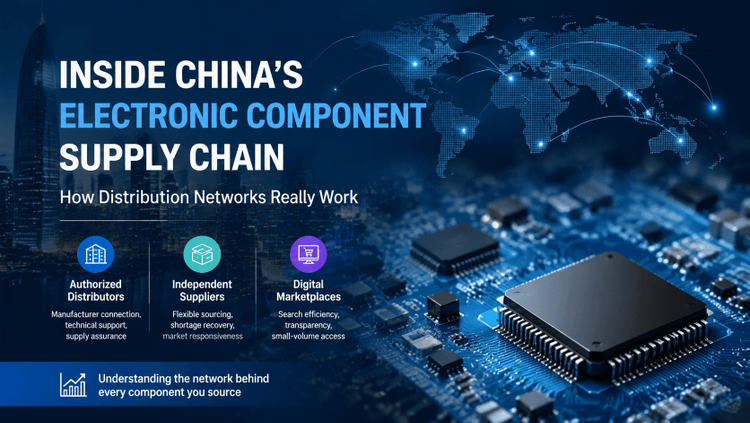
| Channel | Main Capability |
|---|---|
| Authorized Distributor | Manufacturer connection, compliance, technical support |
| Independent Supplier | Speed, flexibility, shortage recovery |
| Marketplace | Search efficiency, transparency, small-volume access |
In practice, global OEMs often use multiple channels depending on:
- Production stage
- Component lifecycle
- Application requirements
- Supply urgency
🔒 Procurement Insight: What Experienced Teams Evaluate
From real component sourcing discussions, experienced buyers usually look beyond price.
Key evaluation factors include:
Traceability
Important questions include:
- Where did the component originate?
- Is the supply history documented?
- Are date codes consistent?
- Can the supplier provide supporting records?
Technical Compatibility
A replacement component is not always equivalent simply because the package and part number look similar.
Engineering teams often verify:
- Electrical parameters
- Thermal characteristics
- Firmware compatibility
- System-level behavior
Supply Reliability
A supplier’s real capability is often revealed during difficult situations.
Experienced teams evaluate:
- Response speed
- Communication quality
- Documentation discipline
- Ability to provide evidence
🚀 Future Direction: A More Connected Component Ecosystem
The future of electronic component sourcing is unlikely to be dominated by a single channel.
Instead, the ecosystem will continue moving toward specialization:
Authorized distributors will focus on:
- Design support
- Manufacturer relationships
- Production programs
Independent suppliers will focus on:
- Flexibility
- Shortage recovery
- Difficult-to-source components
Digital platforms will focus on:
- Search efficiency
- Small-volume purchasing
- Engineering accessibility
The strongest supply networks will combine all three.
✨ Closing
China’s electronic component ecosystem is built on multiple interconnected supply channels.
Understanding how authorized distributors, independent suppliers and digital marketplaces operate provides global OEM and EMS teams with a clearer view of component availability, supply risks and sourcing opportunities.
For companies building long-term supply resilience, the first step is not choosing a single channel.
It is understanding how the entire ecosystem works.