💡 Key Takeaways
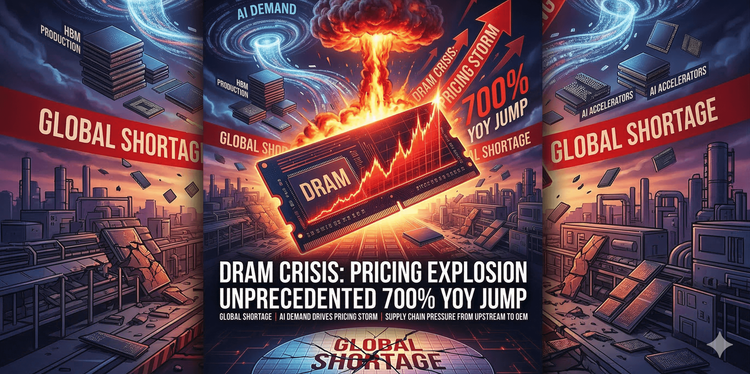
• DRAM contract prices jumped 700% year-over-year in January 2026—the steepest increase in 20 years
• Three major DRAM manufacturers significantly reduced commodity DRAM capacity, prioritizing AI-focused production
• DDR4 market share in China DRAM production plummeted from 37% in 2024 to just 17% in 2025, with forecast suggesting further contraction to 11% this year
• OEMs scrambling for supply amid severe shortage, with spot prices and prepaid orders both hitting record levels
• Silicon wafers also facing pre-sales shortages, adding upstream pressure on the entire supply chain
• SK hynix signaled a longer-than-expected upcycle, driven by AI demand expansion and HBM yield losses
• Long-term supply agreements (3+ years) becoming critical for securing allocation and pricing stability
🎯 Opening
The global memory market experienced an unprecedented pricing surge in early 2026. According to market data, DRAM contract prices skyrocketed 700% year-over-year—the steepest increase in two decades. What began as a gradual upward correction transformed into a full-blown pricing storm by January, leaving procurement teams across the electronics industry scrambling to secure supply.
📊 What's Changing
Three structural shifts are driving this market transformation. First, major DRAM manufacturers are aggressively reallocating production capacity away from commodity DRAM toward AI-focused high-bandwidth memory, including HBM for AI accelerators. Samsung Electronics and SK hynix have both announced significant capacity shifts, with Micron Technology adjusting its portfolio accordingly. Second, commodity DRAM supply is contracting rapidly. Counterpoint Research data shows DDR4 market share in China DRAM production plummeted from 37% in 2024 to just 17% in 2025, with forecast suggesting further contraction to 11% this year. This supply-side compression is transmitting upward pressure throughout the value chain.
📗 Data / Comparison
The pricing divergence is stark across product segments. In January 2026, the benchmark price for mainstream DDR4 8GB modules averaged approximately $13 per unit. By comparison, DDR3 prices remained flat year-over-year, while LPDDR5 saw modest increases. The pricing pressure is concentrated heavily on DDR4 products, which face the tightest supply constraints. Supply data from DRAMeXchange indicates that spot market availability for DDR4 dropped by 20% sequentially in Q4 2025, creating immediate allocation challenges for buyers who lack long-term contracts.
🔍 Why Old Assumptions No Longer Work
The traditional procurement assumption—that DRAM manufacturers would maintain steady commodity DRAM production to support PC and mobile device demand—is breaking down. AI workloads and data center deployments have fundamentally altered demand curves. Manufacturers are now optimizing for high-margin AI accelerators rather than commodity DRAM volumes. This strategic pivot means that the old playbook of securing allocation through long-term relationships no longer guarantees stable supply. The supply chain is becoming increasingly segmented: standard DRAM is allocation-constrained while AI-focused memory has different availability dynamics and pricing structures. Procurement teams must now navigate multiple supplier tiers, negotiate across spot and contract channels, and manage complex qualification requirements.
⚡ Implications for OEM / EMS / Procurement
The implications for procurement teams are severe and immediate. First, cost pressure: 700% price increases directly impact BOM costs, eroding margins for consumer electronics and compressing product pricing strategies. Second, supply risk: with some clients reportedly securing only 50% of their required allocation, making production planning nearly impossible without guaranteed supply. Third, upstream scarcity: silicon wafer shortages are spreading beyond DRAM to other raw materials, suggesting a supply chain contraction that is structural rather than cyclical. Fourth, inventory strategy: spot market purchases are becoming default for many buyers despite premium pricing, necessitating aggressive prepaid orders to secure any available supply. Procurement teams must shift from reactive spot-buying to proactive portfolio management—diversifying suppliers, renegotiating contracts, and building strategic inventory buffers.
🚀 How Smart Teams Are Responding
Leading OEMs and EMS providers are implementing multi-layered strategies to mitigate this crisis. First, diversification: qualifying new DRAM suppliers including second-tier manufacturers with available capacity to reduce dependency on the top three. Second, design adaptation: exploring alternative memory architectures or reducing DRAM content in BOMs where feasible. Third, strategic partnerships: deepening relationships with multiple manufacturers to secure allocation priority, even if it means accepting higher prices or longer lead times. Fourth, market intelligence: closely monitoring spot price trends and manufacturer capacity announcements to anticipate supply shifts and time procurement decisions accordingly. The teams that succeed will be those that move fastest from reactive shortage management to proactive supply chain resilience.
✨ Closing
The DRAM market of 2026 is not just another cycle—it is a structural transformation driven by AI. Procurement strategies that worked for PC-centric supply chains must evolve toward managing allocation complexity, pricing volatility, and tiered supplier ecosystems. Companies that invest in supply chain intelligence and build strategic partnerships now will navigate this transition more effectively than those relying on traditional sourcing models. The question is not whether prices will stabilize, but how procurement teams will adapt to this new normal of constrained supply and segmented availability.
Data Sources: TrendForce, DRAMeXchange, Counterpoint Research, SK hynix corporate communications