Key Takeaways
• The Event: Automotive-grade discretes from Nexperia are experiencing sharp demand spikes, extended lead times, and unstable pricing.
• The Cause: Capacity constraints and concentrated sourcing have pushed availability below market expectations.
• The Implication: OEMs and EMS providers are accelerating alternative qualification to protect production continuity.
🚗 Opening
Over the past quarters, automotive-grade discretes from Nexperia have moved from “preferred choice” to “constrained resource.” Parts such as PESD1LIN and BSS84AK are seeing elevated demand, volatile spot pricing, and lead times stretching beyond 12 weeks. This imbalance between price and real availability is forcing supply chain teams to reassess long-standing sourcing assumptions.
📈 What’s Changing
The current market is no longer defined by a single shortage, but by a pattern: pricing remains firm while allocation tightens. Automotive programs, especially those with mid-volume but high-mix requirements, are finding that nominal availability does not translate into confirmed delivery schedules. As a result, transfer demand is accelerating faster than in previous cycles.
📊 Data / Comparison
Across EMS feedback loops, Nexperia automotive discretes are now commonly quoted with 10–14 week lead times, compared with historical norms of 6–8 weeks. In parallel, qualified alternatives from Taiwanese suppliers are being offered with shorter confirmation windows and less price volatility, even after factoring in qualification and documentation costs.
🔍 Why Old Assumptions No Longer Work
For years, many OEMs assumed that Tier-1 automotive discrete suppliers alone could absorb demand swings. That assumption breaks down when capacity expansion lags behind automotive qualification cycles. Waiting for allocation relief exposes programs to schedule risk, especially when multiple platforms rely on the same ESD or small-signal MOSFET footprints.
🏭 Implications for OEM / EMS / Procurement
For procurement teams, the immediate impact is higher buffer inventory and reduced negotiating leverage. For engineering teams, the challenge is balancing AEC-Q requirements with the practical need for pin-to-pin or near-drop-in replacements. BOM rigidity now translates directly into production risk.
🚀 How Smart Teams Are Responding
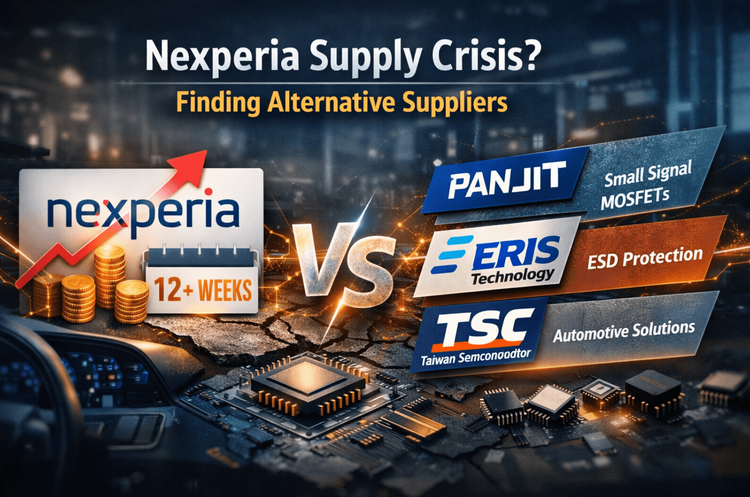
Rather than waiting for shortages to peak, leading OEMs and EMS providers are qualifying parallel sources. Taiwanese suppliers are absorbing a significant share of this transfer demand:
• Panjit: Known for small-signal MOSFETs, with strong high-voltage portfolios and mature pin-compatible options. Commonly adopted in industrial and consumer designs where automotive mandates are flexible.
• Eris Technology: Increasingly visible in ESD protection transfers, supported by an IDM model and more stable capacity following wafer resource integration.
• Taiwan Semiconductor: A long-standing automotive discrete supplier with high acceptance in non-safety-critical applications, albeit with longer qualification cycles for core control parts.
These strategies are less about cost optimization and more about resilience—ensuring that no single supplier constraint can halt a production line.
🔒 Closing
The current cycle reinforces a familiar lesson: supply risk is highest when alternatives are qualified too late. Teams that proactively build secondary and tertiary sources are better positioned to absorb volatility without disrupting vehicle programs. Quietly strengthening optionality today is becoming a defining trait of resilient automotive supply chains.