💡 Key Takeaways
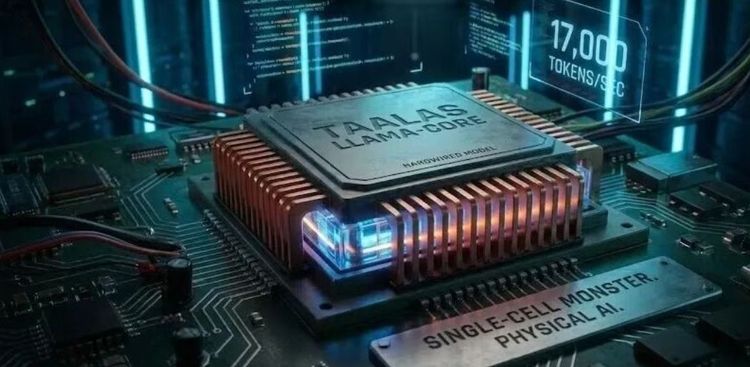
• Taalas HC1 achieves 17,000 tokens/second, outperforming Cerebras by 10x and NVIDIA B200 by 50x
• Hardware-fixed architecture eliminates HBM and liquid cooling, reducing cost by 95% and power by 90%
• The model lock-in trade-off raises fundamental questions about general-purpose vs specialized AI accelerators
🎯 Opening
The AI acceleration landscape just split. A Toronto-based startup, Taalas, unveiled HC1—a chip that hardwires Llama 3.1 8B directly into silicon. The result: 17,000 tokens/second, outperforming Cerebras by 10x and NVIDIA B200 by 50x.
📊 What's Changing
The performance gap stems from architectural differences. HC1 eliminates memory walls by hardwiring model weights directly into transistors. This removes HBM, reduces thermal complexity, and slashes power consumption to 2.5kW for ten chips. Cost drops to 1/20 of traditional GPU systems.
🔍 Why Old Assumptions No Longer Work
Traditional GPU design assumes software flexibility is paramount. Engineers built programmable platforms to support diverse workloads. HC1 challenges this by asking: what if the use case is fixed, static, and known at manufacturing time? The answer: 17,000 tokens/second.
⚡ Implications for OEM / EMS
The trade-off is permanent lock-in. HC1 runs Llama 3.1 8B only. It cannot be fine-tuned, upgraded, or reprogrammed. When Meta releases Llama 4, today's cutting-edge silicon becomes e-waste. For product designers requiring model agility, this approach carries significant lifecycle risk.
🚀 How Smart Teams Are Responding
Two camps are emerging. Traditionalists argue hardware flexibility remains essential. Specialists point to human brain analogies: biological systems are also "hardwired" for specific functions. Vertical applications—voice assistants, automated inspection, embedded edge AI—may not need general-purpose versatility. They need speed and cost efficiency.
✨ Closing
Taalas represents a bet on specialization over generality. Whether this "retro-brutalist" approach defines AI hardware's future or becomes an expensive footnote remains unclear. For procurement teams, the question is immediate: does your application require model agility or raw throughput? Evaluate your use case before committing to hardwired silicon.