💡 Key Takeaways
• XLH11A2 delivers ≥20% CTR with 5000Vrms isolation for industrial signal isolation
• Extended -55℃ to +100℃ operating range supports harsh industrial environments
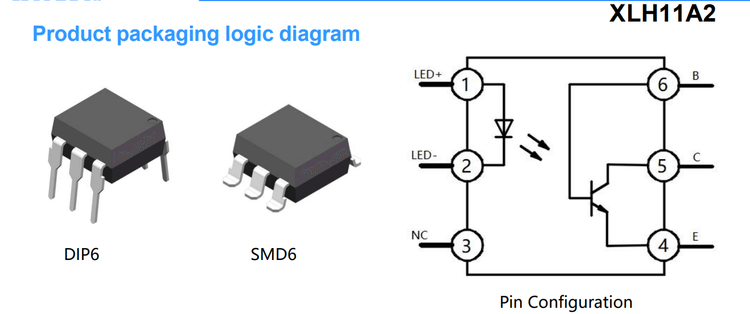
• Available in DIP6 and SMD6 packages for flexible PCB integration
🎯 Opening
Phototransistors serve as critical isolation components in industrial control systems, particularly in applications requiring electrical separation between input and output circuits. This analysis examines XLH11A2 specifications and design considerations for automation equipment and power supply applications.
📊 What's Changing
Industrial automation demands components that combine high isolation voltage with reliable signal transfer characteristics. The XLH11A2 phototransistor addresses this by offering 5000Vrms isolation between input and output alongside a current transfer ratio of ≥20% at IF = 10mA, VCE = 10V.
📗 Data / Comparison
Maximum Ratings show robust design margins. Input forward current reaches 60mA, while collector current capacity extends to 100mA. The device handles reverse voltage up to 6V on the input side and supports collector-emitter voltage of 30V. Thermal performance includes total power dissipation of 350mW and storage temperature range from -55℃ to +125℃.
The response time specification indicates fast switching capability: rise time of 3-10μs and fall time of 3-10μs. This suits applications requiring quick signal detection and isolation in control circuits.
🔍 Why Old Assumptions No Longer Work
Traditional isolation components often compromise between voltage rating and signal transfer efficiency. The XLH11A2 demonstrates that modern phototransistors can maintain high CTR values while meeting stringent isolation requirements.
The package diversity—DIP6 and SMD6—allows designers to choose between manual assembly-friendly formats and automated manufacturing processes. This flexibility matters in production environments where assembly methods determine cost structure.
⚡ Implications for OEM / EMS / Procurement
The extended temperature range enables deployment in extreme environments like industrial plants and outdoor control systems. Engineers designing PLC modules or sensor interfaces can rely on consistent performance across the full -55℃ to +100℃ operating range.
Procurement teams benefit from dual packaging options. DIP6 packages ship 65pcs per tube for prototype and low-volume builds. SMD6 versions come 1000pcs per tape and reel for automated pick-and-place assembly.
The high isolation voltage of 5000Vrms reduces the need for additional isolation circuitry in certain designs. This can simplify BOM complexity and potentially lower overall component count in signal isolation applications.
🚀 How Smart Teams Are Responding
Design engineers targeting industrial automation equipment often specify phototransistors with wide operating temperature ranges upfront. The XLH11A2 fits applications including PLC modules, sensor interfaces, and measurement instrument signal isolation.
For smart meter designs and switching power supplies, the combination of high CTR and fast response times (3-10μs rise/fall) supports efficient signal processing while maintaining necessary safety isolation.
Household appliance control circuits—air conditioning, refrigerators, water heaters—require components that can handle continuous operation in ambient conditions. The XLH11A2 provides both reliability and certification compliance (CQC, UL, VDE).
Renewable energy systems, particularly photovoltaic inverters and energy storage applications, benefit from robust isolation components that can withstand outdoor temperature variations. The -55℃ to +100℃ range supports deployment in diverse climatic zones.
✨ Closing
Phototransistor selection significantly impacts signal isolation reliability in industrial applications. The XLH11A2 offers balanced specifications for automation equipment, power systems, and household appliance control circuits. Engineers evaluating isolation requirements should consider CTR values, isolation voltage, and operating temperature ranges when specifying components for new designs.