💡 Key Takeaways
• Automotive MCU market grows from $15.5B in 2025 to $34.1B by 2035 (8.2% CAGR)
• Luxury vehicle demand drives 32-bit MCU adoption (40.10% share by 2035)
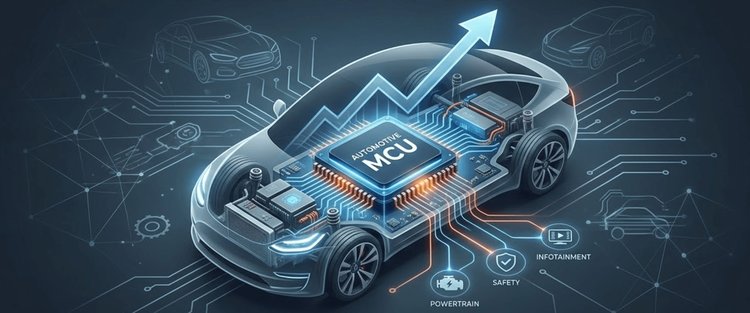
• Powertrain, safety systems, and infotainment are primary growth applications
🎯 Opening
The automotive microcontroller market is experiencing unprecedented growth, fueled by the rapid expansion of vehicle electronics. As automakers integrate advanced features across powertrain, safety, and infotainment systems, MCU demand is projected to triple within a decade.
📊 What's Changing
The global automotive MCU market reached $15.5 billion in 2025 and is forecast to reach $34.1 billion by 2035, representing a compound annual growth rate of 8.2%. This expansion exceeds the broader semiconductor market growth rate, highlighting the strategic importance of automotive applications.
Current market valuation exceeds $4 billion, with projections reaching $6.5-7 billion by 2028. The growth trajectory reflects a structural shift toward software-defined vehicles where MCUs control critical functions from engine management to autonomous driving features.
📗 Data / Comparison
32-bit MCUs dominate the automotive landscape, capturing 40.10% market share by 2035. This preference stems from the need for high-performance computing in advanced driver assistance systems (ADAS) and real-time vehicle communication.
Segment growth varies by application:
- Powertrain & Chassis: Engine control, transmission management
- Safety & Security: Airbag deployment, brake systems, stability control
- In-vehicle Infotainment: Display systems, navigation, connectivity
- Telematics: Remote diagnostics, over-the-air updates
🔍 Why Old Assumptions No Longer Work
Historically, automotive semiconductor sourcing focused on cost optimization and standardization. The market has shifted toward performance, reliability, and security. Legacy 8-bit MCUs are being phased out for 16-bit and 32-bit alternatives that support complex algorithms required by modern vehicle architectures.
The assumption that vehicle electronics would plateau is incorrect. Electric vehicle sales are projected to be 3 million higher in 2024 than 2022, creating sustained demand for powertrain MCUs and battery management systems.
⚡ Implications for OEM / EMS / Procurement
Procurement teams face tightening supply for automotive-grade MCUs with extended lead times. Component selection criteria have evolved from basic functionality to include cybersecurity certifications, temperature resilience (-40°C to 125°C), and AEC-Q100 compliance.
BOM complexity increases as vehicle manufacturers integrate multiple MCUs across subsystems. Strategic sourcing requires diversification across suppliers and qualification of second-source options to mitigate supply chain risks.
🚀 How Smart Teams Are Responding
Leading automotive manufacturers establish direct partnerships with MCU suppliers to secure allocation for strategic vehicle programs. Engineering teams adopt modular architectures that allow MCU substitution without redesigning entire subsystems.
Supply chain teams implement just-in-time delivery models while maintaining safety stock for critical components. Some OEMs co-develop custom MCU solutions with semiconductor manufacturers to optimize performance for specific vehicle architectures.
✨ Closing
The automotive MCU market presents sustained growth opportunities driven by technological advancement and regulatory mandates. Partnerships with established suppliers and strategic supply chain planning will be critical for securing allocation in this expanding market. Reach out to discuss resilience strategies for automotive microcontroller sourcing.