💡 Key Takeaways
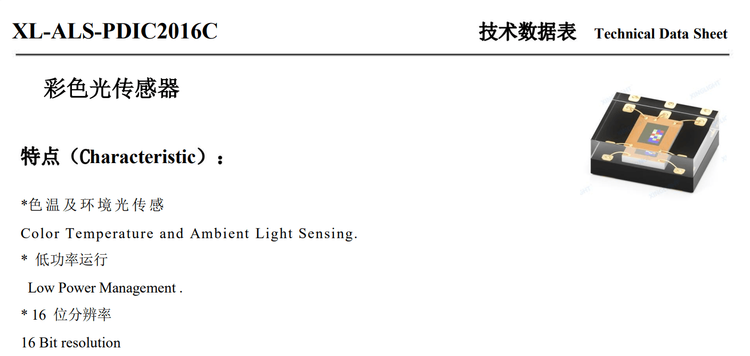
• XL-ALS-PDIC2016C provides 16-bit resolution with programmable gain and integration time
• Low power operation supports battery-powered and portable device applications
• Wide operating range from -30℃ to 70℃ for diverse deployment environments
🎯 Opening
Color sensors and ambient light sensing have become critical components in modern electronic devices. The XL-ALS-PDIC2016C addresses this demand by combining color temperature detection with brightness sensing in a single compact package, making it suitable for notebooks, handheld devices, and scanning equipment.
📊 What's Changing
Consumer electronics increasingly require accurate color and brightness detection for display calibration, ambient light adaptation, and power management. The XL-ALS-PDIC2016C responds with 16-bit resolution that delivers precise color temperature readings alongside ambient light measurements.
📗 Data / Comparison
Electrical specifications show efficient power management. The sensor operates on supply voltage from 2.6V to 3.6V, with active supply current maximum of 350μA. Sleep mode demonstrates additional power efficiency—10μA at ADDR high and 16-25μA at ADDR low.
Output specifications support multiple design configurations. Sink capability handles 4mA with 0.4V maximum low-level output or 6mA with 0.6V maximum low-level output. Input voltage thresholds are set at 30% of VDD for low level and 70% of VDD for high level.
🔍 Why Old Assumptions No Longer Work
Traditional color sensors often compromise between resolution and power consumption. The XL-ALS-PDIC2016C demonstrates that 16-bit accuracy can be achieved with maximum 350μA active current—far below typical power budgets for battery-operated devices.
The programmable gain and integration time parameters allow designers to optimize performance for specific applications. This flexibility enables the same sensor to handle different lighting conditions without hardware changes.
⚡ Implications for OEM / EMS / Procurement
The extended operating temperature range of -30℃ to 70℃ supports deployment in diverse environments. Industrial applications requiring outdoor exposure or extreme cold conditions can rely on consistent performance across the full specification range.
Low power characteristics enable battery-powered device integration. Notebooks and handheld equipment benefit from sleep mode currents as low as 10μA, extending battery life without sacrificing sensing accuracy.
🚀 How Smart Teams Are Responding
Brightness sensing applications utilize the sensor's ability to detect ambient light levels for automatic display brightness adjustment and power management. This reduces user intervention and improves energy efficiency.
Color temperature sensing supports display calibration and white balance adjustment in imaging systems. Scanners and display applications benefit from accurate color temperature detection for consistent color reproduction.
The 16-bit resolution enables fine-grained control in lighting systems. Programmable parameters allow system engineers to configure gain and integration time based on specific application requirements rather than hardware redesign.
✨ Closing
Color and ambient light sensing requirements continue to evolve across consumer electronics and industrial applications. The XL-ALS-PDIC2016C provides 16-bit resolution with programmable flexibility and low power operation for device integration. Engineers evaluating color sensing solutions should consider resolution accuracy, power consumption characteristics, and programmable configuration options when specifying components for new designs.