📌 Product Overview
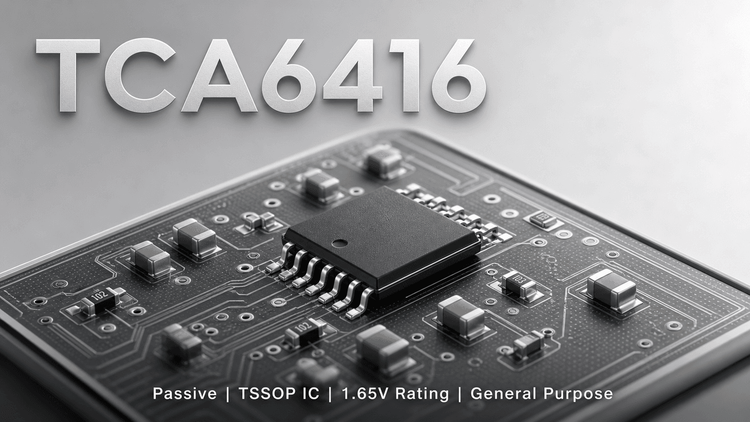
The TCA6416 is a 16-bit I²C and SMBus I/O expander with interrupt output and reset functionality. Designed to interface with microcontrollers via a two-line bidirectional bus, it solves the problem of limited GPIO pins. By operating from 1.65 V to 5.5 V on both the P-port and the I²C side, it facilitates bidirectional voltage-level translation. This makes it ideal for bridging low-voltage microcontrollers (1.8 V) with higher-voltage peripherals (5 V), such as legacy indicators or sensors.
🎯 Typical Applications & Design Context
- Voltage Level Translation: Bridges the gap between next-gen low-power MCUs (1.8 V/2.5 V) and 5 V peripheral buses.
- GPIO Expansion: Adds 16 additional I/O lines via a single I²C address, reducing MCU pin count and PCB complexity.
- LED Status Indication: Features high-current sink capability on P-ports to directly drive LEDs without external buffers.
- Power Management & Control: Utilizes the active-low interrupt (INT) output to signal the master only when input states change, significantly reducing polling overhead and system power consumption.
📊 Key Technical Specifications
| Parameter | Specification | Engineering Impact |
|---|---|---|
| Supply Voltage Range (VCC) | 1.65 V to 5.5 V | Supports flexible power rail designs; no separate LDO required for level shifting. |
| I²C Frequency | 400 kHz (Fast Mode) | Ensures rapid data transfer for control and status updates. |
| P-Port Drive | High-current sink | 💡 Directly drives LEDs; saves BOM cost on transistors. |
| Interrupt Logic | Open-Drain Active-Low | Allows multiple expanders to share a single interrupt line (Wire-OR configuration). |
| Standby Current | 1 μA | Critical for battery-operated devices; minimizes leakage load. |
| Address Selection | 1 Hardware Pin (ADDR) | Allows up to 2 devices on a single I²C bus. |
⚠️ Absolute Maximum Ratings & Process Limits
| Rating | Value | Process & Reliability Impact |
|---|---|---|
| Supply Voltage | -0.5 V to +6.0 V | Exceeding 6 V risks permanent gate oxide damage to the CMOS I/O structures. |
| Input Current | ±20 mA | Current exceeding this limit (e.g., ESD surge or miswired short) can vaporize metal traces. |
| Continuous Output Current | ±50 mA per pin | Aggregate current limits must be respected. Thermal failure occurs if total dissipation exceeds package capacity. |
| Operating Temp. | -40°C to +125°C | Standard industrial range. Convection cooling may be required near max current. |
| ESD Protection | 2000 V HBM | ⚠️ While robust, standard handling precautions (grounded mats) are mandatory during board assembly to prevent latent defects. |
🧩 Package, Dimensions & Assembly Notes
The TCA6416 is available in three surface-mount packages: TSSOP (24), WQFN (24), and BGA (24).
- Footprint Compatibility: The WQFN (4mm x 4mm) offers the smallest footprint for dense designs but requires X-ray inspection for solder joint verification due to the center thermal pad.
- SMT Validation: The TSSOP (7.80mm x 4.40mm) is the most forgiving for wave soldering if selective pallets are used.
- Thermal Management: The WQFN and BGA packages utilize exposed thermal pads. Ensure proper thermal relief connections to the ground plane to dissipate heat generated by high LED currents.
🔍 Procurement & Sourcing Insights
- ⚠️ Lifecycle Status: The datasheet explicitly marks this device as "Not Recommended for New Designs" (NRND). LDeepAI strongly advises against using this for new product introductions (NPI).
- Supply Risk: As an NRND part, long-term availability is volatile. Sourcing relies on spot market inventory (often Huaqiangbei excess stock) or Last Time Buy (LTB) orders.
- Alternatives: For new designs, consider the TCA6424 (pin-compatible upgrade) or TCA9535/TCA9539 families.
- Authenticity: Given the age of this part, secondary market risk is high. Always verify traceability codes to avoid refurbished or counterfeit silicon.
❓ FAQ
Q: Can I use the TCA6416 to interface a 3.3 V MCU with a 5 V LED array?
A: Yes. The TCA6416 supports bidirectional voltage-level translation. You can power the I²C side (SCL/SDA) at 3.3 V and the P-port side (VCCP) at 5 V, allowing the MCU to safely control 5 V loads without logic-level shifters.
Q: What is the difference between the TCA6416 and TCA6407A?
A: The primary difference is the port count and addressing. The TCA6416 offers 16 ports and allows up to 2 devices on the bus via 1 address pin. The TCA6407A typically offers fewer ports. Additionally, the TCA6416's high-current sink is optimized for direct LED drive, whereas some general-purpose expanders may require external buffering.
Q: How do I handle the interrupt (INT) pin in my firmware?
A: The INT pin is active-low and open-drain. It triggers when an input port state differs from the input register. In your ISR (Interrupt Service Routine), read the Input Port register via I²C to clear the interrupt. Do not leave the INT pin floating; connect a pull-up resistor to the corresponding logic voltage rail.
Q: Is the "Not Recommended for New Designs" status a deal-breaker for legacy products?
A: For active maintenance of legacy systems (repair/replacement), it is acceptable to source existing stock. However, for cost-sensitive mass production, the NRND status often leads to premium pricing for authorized stock. Sourcing teams should aggressively qualify pin-to-pin alternatives like the TCA9535 to mitigate supply chain risks.