📌 Product Overview
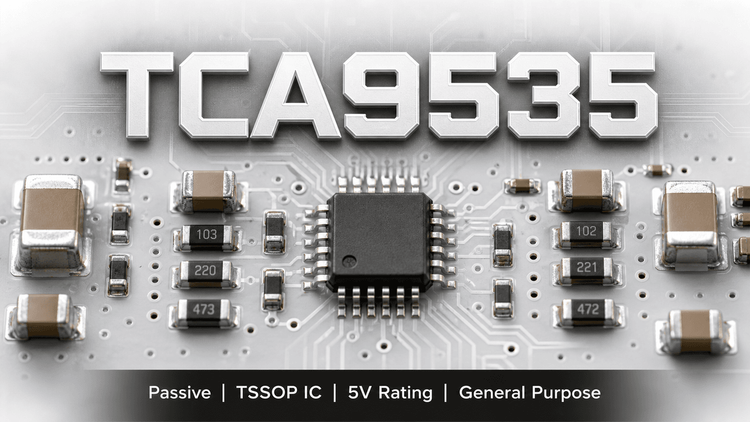
The TCA9535 is a 16-bit I2C and SMBus I/O expander designed to extend the GPIO capabilities of processors via a two-line bidirectional interface. Unlike the similar TCA9555, this model omits internal pull-up/pull-down resistors, offering greater design flexibility but requiring strict external bias management. It is ideally suited for space-constrained industrial automation, servers, and personal electronics where the host MCU lacks sufficient I/O pins. Engineers must prioritize the "No Internal Pull-up" characteristic and 5-V tolerant I/O ports during system design to ensure signal integrity.
🎯 Typical Applications & Design Context
This device is critical for systems requiring I/O expansion without increasing the processor pin count.
- Server & Telecom Routers: Used for management panel LEDs and status monitoring due to its high-current drive capability.
- Industrial Automation: Ideal for GPIO expansion in PLCs or sensor hubs, leveraging the wide 1.65 V to 5.5 V supply range to interface with mixed-voltage logic.
- Gaming Consoles & PCs: Expands control for button matrices or peripheral interfacing.
- Design Note: 💡 Its Active-Low Interrupt Output allows the host to mask polling, significantly reducing CPU overhead in event-driven designs.
📊 Key Technical Specifications
| Parameter | Value/Condition | Engineering Note |
|---|---|---|
| Supply Voltage (VCC) | 1.65 V to 5.5 V | Wide range allows direct connection to 3.3V or 5V buses. |
| I/O Port Voltage | 5-V Tolerant | Safe for interfacing 5V logic even when VCC is 3.3V. |
| I2C Frequency | 400 kHz (Fast Mode) | Standard speed for control planes; timing varies with VCC. |
| I/O Drive Strength | High Current (LED drive) | Can directly drive indicators; verify current sink limits. |
| Standby Current | Low (µA range) | Critical for battery-powered or standby-sensitive equipment. |
⚠️ Absolute Maximum Ratings & Process Limits
Exceeding these ratings risks permanent damage to the silicon or bond wires during operation or SMT assembly.
| Parameter | Rating | Failure Mode / E-E-A-T Insight |
|---|---|---|
| VCC Terminal Voltage | -0.5 V to 6.0 V | >6.0V causes oxide breakdown. ⚠️ Verify power rail transients. |
| Input Voltage (VI) | -0.5 V to 6.0 V | Exceeding -0.5V causes latch-up. Ensure ground references are stable. |
| Continuous Output Current | ±25 mA per I/O | ⚠️ Thermal Risk: While capable of driving LEDs, exceeding 10mA on multiple pins simultaneously can violate the package power dissipation limit (Tj max), leading to thermal shutdown or bond wire fatigue. |
| ESD Protection (HBM) | 2000 V | Standard handling; ESD bags required during Huaqiangbei logistics. |
| Storage Temperature | -65 °C to 150 °C | Moisture sensitivity (MSL) applies. Improper bake-out causes "popcorning" during reflow. |
🧩 Package, Dimensions & Assembly Notes
The TCA9535 is available in TSSOP (24), SSOP (24), and VQFN/WQFN (24) packages.
- Footprint: The VQFN (4.00mm x 4.00mm) offers the smallest footprint for dense designs but requires an exposed thermal pad (EP) soldering to the PCB ground plane for heat dissipation.
- SMT Validation: The TSSOP (7.80mm x 4.40mm) provides easier visual inspection for hand soldering or rework.
- Process: Standard SnPb or Pb-free reflow profiles apply. ⚠️ Attention: Ensure wave soldering flux does not bridge the fine pitch (0.65mm) leads on TSSOP variants.
🔍 Procurement & Sourcing Insights
- Alternative Validation: The TCA9535 is often cross-referenced with NXP PCA9555. ⚠️ Critical Difference: The NXP part typically includes internal pull-ups. If you replace TCA9535 with PCA9555 without removing external pull-ups, you may create logic conflicts; if you replace PCA9555 with TCA9535, floating inputs will cause random interrupts.
- Supply Chain Risk: As a legacy/logic part, lead times can fluctuate. TI authorized channels guarantee date codes, while open market brokers (Shenzhen/HQ) may offer older stock. Verify "Rev May 2022" or newer for errata fixes.
- Authenticity Check: Check package marking consistency (TI logo, date code) and perform I2C acknowledge testing at VCC=1.65V to weed out counterfeit logic chips.
❓ FAQ
Q: What is the difference between TCA9535 and TCA9555?
A: The primary difference is the internal resistors. The TCA9535 has no internal pull-up/pull-down resistors on the I/O pins, while the TCA9555 does. The TCA9535 requires external resistors on inputs to prevent floating states, whereas the TCA9555 can be used without them (though external ones are still recommended for noise immunity).
Q: Can I use this device to interface a 5V signal to a 3.3V MCU?
A: Yes. The datasheet specifies 5-V tolerant I/O ports. This means you can apply 5V logic levels to the P-ports even when the device is powered by 3.3V VCC, making it an excellent level shifter/expander for mixed-voltage systems.
Q: What happens if I leave unused pins floating?
A: Since there are no internal pull-ups, floating pins configured as inputs will oscillate, leading to increased current consumption (ICC) and potential random interrupts on the INT line. All unused input pins must be terminated to VCC or GND via resistors.
Q: How many TCA9535 devices can I connect to one I2C bus?
A: Up to 8 devices. The device uses 3 hardware address pins (A0, A1, A2), providing 2³ = 8 unique addresses. Ensure your bus capacitance does not exceed 400 pF when using all 8 devices, or reduce the I2C clock speed.