📌 Product Overview
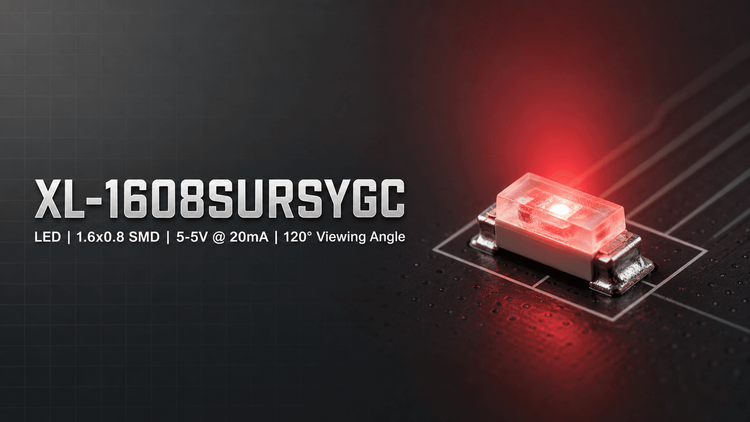
The XL-1608SURSYGC is a 0603 (1608 metric) surface-mount Red/Yellow/Green (RYG) LED designed for high-density indication and backlighting. It utilizes a transparent colloid to maximize light output while maintaining a compact footprint of 1.6x0.8mm. For engineering teams, the critical selection variables are the forward voltage (Vf) uniformity and brightness binning, which directly impact color consistency in status indicators and keypad backlighting. As an EIA-standard compliant component, it ensures seamless compatibility with modern automated SMT assembly lines.
💡 Typical Applications & Design Context
Due to its compact form factor and tri-color capability, this component is optimized for space-constrained consumer electronics:
- Mobile Devices: Keypad backlights and status indicators where board real estate is premium.
- Consumer Appliances: Status display panels requiring clear visual feedback (Red/Yellow/Green logic states).
- Industrial Instrumentation: Pilot lamps and signal towers needing wide viewing angles.
- Design Rationale: The transparent colloid and 120-degree viewing angle make it ideal for applications requiring light diffusion or uniform indicator glow, rather than focused point sources.
⚡ Key Technical Specifications
The following table highlights the performance windows under standard test conditions (Ta=25°C). Engineers should note the separation between Red (R) and Yellow/Green (YG) optical characteristics.
| Parameter | Symbol | Red (R) Value | Yellow/Green (YG) Value | Unit | Notes |
|---|---|---|---|---|---|
| Forward Current | If | 20 | 20 | mA | Standard operating condition |
| Forward Voltage | Vf | 1.8 - 2.4 | 1.8 - 2.4 | V | Max @ 20mA; Critical for driver design |
| Luminous Intensity | Iv | 120 (Typ) | 50 (Typ) | mcd | Measured @ 20mA |
| Dominant Wavelength | λd | 620-625 | 565-575 | nm | Defines color perception |
| Viewing Angle | 2θ1/2 | 120 | 120 | deg | Wide angle for indicators |
| ESD Capability | ESD | 2000 | 2000 | V | Human Body Model (HBM) |
🚨 Absolute Maximum Ratings & Process Limits
Exceeding these parameters risks catastrophic silicon degradation or delamination.
| Parameter | Symbol | Rating | Unit | E-E-A-T Insight (Failure Mode) |
|---|---|---|---|---|
| Power Dissipation | Pd | 50 | mW | Exceeding this causes thermal runaway and junction overheating. |
| Peak Forward Current | Ifp | 60 | mA | Pulse width ≤0.1ms. Longer pulses will bond wire fusing. |
| Reverse Voltage | Vr | 5 | V | >5V reverse bias causes junction breakdown, leading to leakage failure. |
| Storage Temp | Tstg | -40~85 | °C | Extreme storage humidity necessitates baking before use (MSL3). |
| Soldering (Reflow) | Tsol | 260 / 6s | °C / s | >260°C or prolonged heat risks epoxy detachment and lens yellowing. |
🏗️ Package, Dimensions & Assembly Notes
- Package: 1608 Metric (Imperial 0603).
- Dimensions: 1.6 (L) x 0.8 (W) x 0.6 (H) mm.
- Moisture Sensitivity:MSL Level 3.
- Critical Action: Floor life is 168 hours after opening the vacuum seal. If not used within this window, components must be baked at 80°C for 24 hours to prevent "popcorning" (internal cracking) during reflow.
- Soldering: Compatible with standard Lead-Free reflow profiles (Peak 245°C). Manual welding is possible but must not exceed 300°C for >3 seconds to avoid damaging the epoxy lens.
🚀 Procurement & Sourcing Insights
- Bin Sorting Strategy: The datasheet indicates availability of multiple brightness (D1-D5) and voltage (N/M) bins. For mass production, strict procurement specifications must lock these bins. Mixing bins (e.g., D1 and D5) on the same panel will result in visible uneven brightness.
- Supply Chain Reality: As a standard component, availability is generally high, but specific "Yellow-Green" wavelength bins (HYG04-HYG06) often have lower stock turnover than pure Red or Green. Procurement should verify the specific wavelength bin availability to avoid unwanted color shifts in the final product.
- Traceability: When sourcing from the Huaqiangbei spot market or non-franchise distributors, always cross-reference the packaging date code. MSL 3 components older than 12 months require re-qualification baking, regardless of seal integrity.
❓ FAQ
Q: What happens if I mix the "R" and "YG" bins on the same PCB?
A: The datasheet lists different typical luminous intensities (120mcd for Red vs. 50mcd for Yellow/Green). If you drive them with the same resistor value without adjusting for the Vf difference, the brightness will be visually mismatched. You must calculate current-limiting resistors separately for R and YG channels.
Q: Can I use a standard reflow profile for this LED?
A: Yes, but strictly adhere to the 260°C peak for 6 seconds maximum. Since this is an MSL 3 device, the most critical factor is ensuring the components have not been exposed to ambient moisture for more than 168 hours prior to placement.
Q: How critical is the 2000V ESD rating?
A: 2000V is relatively low compared to protection diodes. During manual assembly (hand soldering) or testing, operators must use grounded wrist straps and ionizers. A static shock could instantly kill the LED or cause latent dimming.
Q: The forward voltage range is 1.8-2.4V. Which value should I use for my circuit design?
A: For worst-case design, assume 2.4V to ensure current does not exceed limits. For brightness consistency in mass production, select a specific voltage bin (e.g., N11-4: 1.9-2.1V) from the supplier to minimize variation between units.