📌 Product Overview
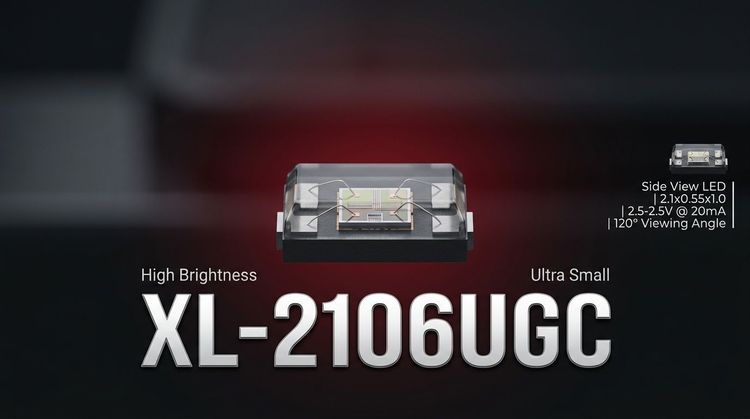
The XL-2106UGC is a compact, high-brightness Emerald Green SMD LED designed by XINGLIGHT. With a miniature package footprint of 2.1x0.55x1.0mm, this component targets space-constrained applications like status indicators, backlighting, and compact consumer electronics. Its core value lies in the balance of high luminous intensity (up to 1300 mcd) and a wide 120° viewing angle, ensuring excellent visibility in dense PCBA layouts (Home Appliances, Toys) and automotive instrument clusters. For engineering teams, the critical selection variable shifts from basic brightness to forward voltage (Vf) consistency and thermal management during SMT processes.
💡 Typical Applications & Design Context
Based on the 120° viewing angle and high-intensity emerald green emission (λd 515-530nm), the XL-2106UGC is optimized for scenarios requiring diffuse but bright illumination:
- Consumer & PCBA: Power status indicators, router signal lights, and HMI feedback.
- Automotive Electronics: Dashboard indicators and interior ambient lighting (non-critical).
- Toys & Gifts: Light guides requiring uniform color mixing in small form factors.
- Industrial/Traffic: Control panel signal lights.
💡 Why this fits: The low thermal mass of the 0.55mm width makes it ideal for high-density boards, but it necessitates strict adherence to reflow profiles to prevent thermal shock.
⚡ Key Technical Specifications (Ta=25°C)
| Parameter | Symbol | Min | Typ. | Max | Unit | Conditions |
|---|---|---|---|---|---|---|
| Luminous Intensity | Iv | 600 | - | 1300 | mcd | IF = 20mA |
| Forward Voltage | Vf | 2.5 | - | 3.3 | V | IF = 20mA |
| Peak Wavelength | λp | - | 525 | - | nm | IF = 20mA |
| Dominant Wavelength | λd | 515 | - | 530 | nm | IF = 20mA |
| Viewing Angle | 2θ1/2 | - | 120 | - | deg | IF = 20mA |
| ESD Capability | ESD | - | - | 2000 | V | (Human Body Model) |
🚨 Design Insight: The wide spread in Vf (2.5V - 3.3V) requires binning selection if the LED is driven by a constant voltage source with limiting resistors, to ensure consistent brightness across batches.
⚠️ Absolute Maximum Ratings & Process Limits
Exceeding these parameters compromises the silicon die and encapsulant integrity.
| Parameter | Symbol | Value | Unit | Notes |
|---|---|---|---|---|
| Max Power Dissipation | Pd | 70 | mW | Derate above 25°C ambient |
| Max Continuous Forward Current | If | 20 | mA | |
| Peak Forward Current | Ifp | 80 | mA | Pulse width ≤0.1ms, Duty ≤1/10 |
| Max Reverse Voltage | Vr | 5 | V | |
| Operating Temperature | Topr | -40 ~ +85 | °C |
🔒 E-E-A-T Validation Reality:
While the datasheet permits an 80mA peak pulse, engineering teams must verify the PCB trace width. On a 0.55mm wide pad, excessive current density can cause delamination. Furthermore, the ESD rating of 2000V is relatively standard; for automated pick-and-place lines, improper grounding can lead to latent failures (reduced brightness) that pass QC but fail in the field.
📦 Package, Dimensions & Assembly Notes
- Package: 2106 Metric (2.1mm x 0.55mm x 1.0mm).
- Soldering: Compatible with standard Reflow Soldering.
- MSL (Moisture Sensitivity Level):Level 3.
- Requirement: Floor life < 168 hours. If opened for > 168 hours (1 week), baking is required (125°C for 24-48 hours typically) to prevent "popcorning" (internal cracking) during reflow.
- Thermal Shock: Resists 260°C for ≤6 seconds (Manual welding) or 255°C (Lead-free Reflow peak).
💡 Assembly Tip: The wide viewing angle is achieved by the lens geometry. During SMT, ensure the placement nozzle force is minimized to avoid micro-scratches on the water-clear lens, which would scatter light and reduce intensity.
🔗 Procurement & Sourcing Insights
- Bin Code Management: XINGLIGHT uses specific codes (e.g., E6-F2 for Brightness, HG02-HG04 for Wavelength, N11-N12 for Voltage). For mass production, always lock the bin code (e.g., E8/N11-8/HG03) to prevent visual color shifts between production lots.
- Alternative Strategy: Cross-referencing to Tier-1 brands (like Everlight or Lite-On) is feasible for the 2106 package, but the pad layout may differ slightly. Always verify the "solder mask opening" before switching vendors to avoid solder bridging on the narrow 0.55mm width.
- Availability: As a standard Emerald Green component, lead times are generally stable (4-6 weeks), but moisture-sealed packaging integrity is the primary supply chain risk to inspect upon receipt.
❓ FAQ: Engineering & Sourcing Validation
Q: Can I drive this LED at 30mA continuously for higher brightness?
A: No. The Absolute Max Continuous Current is 20mA. Driving at 30mA will rapidly degrade the epoxy colloid and shift the wavelength, shortening the lifespan significantly. Use the pulsed mode (80mA) only for short bursts.
Q: The Vf range is 2.5V-3.3V. How does this affect my resistor calculation?
A: You must design for the worst-case scenario. If your power supply is 5V and you aim for 20mA, calculate the resistor using the lowest Vf (2.5V) to prevent current overflow: R = (5V - 2.5V) / 0.02A = 125Ω. If you calculate using 3.3V, the actual current could exceed the limit when a low-Vf bin is installed.
Q: What is the risk if I skip the baking process for MSL 3 components?
A: MSL 3 allows 168 hours (1 week) of floor life. If the component has been exposed longer, internal moisture vaporizes during reflow peak (255°C), expanding and cracking the encapsulant or delaminating the die attach. This leads to immediate failure or intermittent reliability issues.
Q: Is the 120° viewing angle suitable for light guides in automotive dashboards?
A: Yes, the wide angle is beneficial for coupling into light pipes. However, for dashboard applications, ensure the Wavelength Bin (HG) is strictly controlled. A 10nm shift (515nm vs 530nm) can be visibly distinct to the end-user in a cluster of gauges.