📌 Product Overview
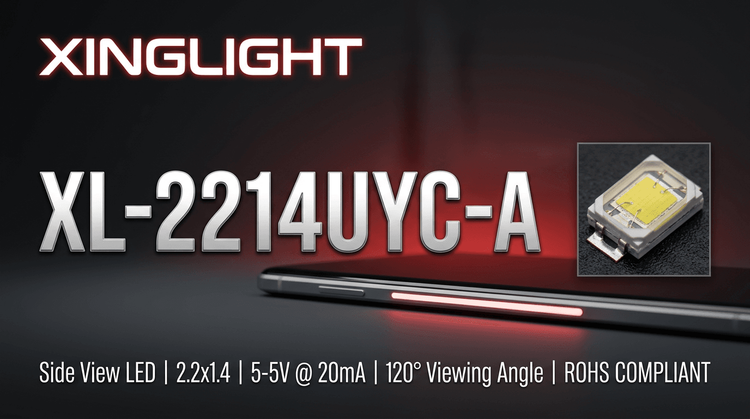
The XL-2214UYC-A from XINGLIGHT is a surface-mount device (SMD) LED designed for high-density electronic assemblies. 💡 It features a compact 2214 package (2.2mm x 1.4mm) emitting yellow light with high luminous intensity. This component targets engineers requiring reliable performance in commercial lighting and automotive interiors, where board space is limited but brightness is critical. ✨ The design focus balances optical output with robust thermal management and automated assembly compatibility.
🎯 Typical Applications
Based on its 120-degree viewing angle and robust temperature range, this model fits the following use cases:
- Commercial Lighting: Ideal for advertising lightboxes and display signage requiring uniform illumination.
- Automotive Interiors: Suitable for dashboard indicators and cabin lighting due to stability at -40°C to +85°C.
- LCD Backlighting: Provides consistent color for small display panels.
- Flexible Strips: The compact 2.2x1.4mm footprint allows for high-density integration on decorative light strips.
📊 Key Technical Specifications
⚡ These parameters define the optical performance window under standard test conditions (Ta=25°C):
| Parameter | Symbol | Test Conditions | Min | Typ | Max | Unit |
|---|---|---|---|---|---|---|
| Luminous Intensity | IV | IF=20mA | 800 | -- | 1000 | mcd |
| Dominant Wavelength | λd | IF=20mA | 585 | -- | 595 | nm |
| Forward Voltage | VF | IF=20mA | 1.7 | -- | 2.3 | V |
| Viewing Angle | 2θ1/2 | IF=20mA | -- | 120 | -- | deg |
| Reverse Current | IR | VR=5V | -- | -- | 1 | μA |
👇 Note: Grading codes (E8/E9 for brightness, HY03-HY06 for wavelength) allow for tighter binning during procurement.
🚨 Absolute Maximum Ratings & Process Limits
🔒 Exceeding these boundaries risks permanent damage or catastrophic failure. Design margins must account for these limits:
| Parameter | Symbol | Value | Unit | Notes |
|---|---|---|---|---|
| Power Dissipation | Pd | 50 | mW | Derate above 25°C ambient |
| Forward Current | IF | 20 | mA | Continuous DC operation |
| Peak Forward Current | IFP | 80 | mA | 1/10 Duty, 0.1ms Pulse |
| ESD Tolerance | ESD | 2000 | V | Human Body Model (HBM) |
| Operating Temp | Topr | -40 ~ +85 | °C | Junction temperature limit |
| Storage Temp | Tstg | -40 ~ +85 | °C | MSL Level 3 compliant |
⚠️ Warning: Soldering temperature must not exceed 260°C for longer than 6 seconds to prevent epoxy damage.
📦 Package, Dimensions & Assembly Notes
✨ The physical design supports standard SMT processes while ensuring mechanical stability.
- Outline: 2.2mm (L) x 1.4mm (W) x 1.35mm (H). Tolerance is generally ±0.25mm unless noted.
- Moisture Sensitivity: Classified as MSL 3. Components must be baked (per J-STD-033) if exposed to ambient moisture before reflow to prevent "popcorning."
- Soldering Guidelines:
- Reflow: Use the recommended Pb-free profile. Reflow cycles should not exceed 2 times.
- Hand Soldering: Only for repair. Use an iron <30W, tip <300°C, for <3 seconds per pad.
- Stress: Do not apply mechanical pressure to the lens during heating.
🤝 Sourcing & Supply Considerations
- Supply Chain: Verify authenticity through XINGLIGHT authorized channels to avoid counterfeit or off-spec brightness grades.
- Sample Evaluation: Request specific binning codes (e.g., HY05 wavelength) to ensure color consistency in your application.
- Production Volume: EIA standard packaging (tape and reel) ensures compatibility with automated pick-and-place machines for mass production.
- Technical Support: For reliability testing data beyond the datasheet summary, contact the factory directly.
❓ FAQ
Q: What does MSL Level 3 mean for my assembly line?
A: MSL 3 means the LED can be exposed to room air (≤30°C/60% RH) for 168 hours (one week) after the vacuum seal is broken before it must be soldered. If stored longer, you must bake the components to remove moisture before reflow soldering to prevent internal cracking.
Q: Can I drive this LED at 30mA for higher brightness?
A: No. While a pulse can handle 80mA, the Absolute Maximum Continuous Forward Current is 20mA. Driving it continuously at 30mA will rapidly degrade the epoxy and chip, shortening the lifespan significantly. You can pulse it, but the duty cycle must be low.
Q: Why are there voltage codes like N11-3 and N11-4?
A: These are voltage grading bins. N11-3 (1.7-1.9V) and N11-4 (1.9-2.1V) ensure that LEDs in a single batch have similar forward voltages. Mixing bins can cause uneven brightness in series strings or matching issues in parallel circuits.
Q: Is this LED suitable for outdoor street lighting?
A: Not recommended. While the operating temperature range is wide (-40°C to +85°C), the IP rating and ingress protection of the SMD package itself are not designed for direct water exposure. It requires an enclosure with an IP65+ rating for outdoor use.
Q: What is the recommended reflow profile for this component?
A: The datasheet references a standard Pb-free profile. Generally, this means a peak temperature of 240°C-250°C is safe, but never exceed 260°C. The time above 217°C (liquidus) should be kept between 30-60 seconds.
Q: How do I verify if I received the correct brightness bin?
A: Check the label on the reel/box for codes like E8 (800-900mcd) or E9 (900-1000mcd). If precise brightness matching is critical for your display, you should specify a single bin code in your purchase order.