📌 Product Overview
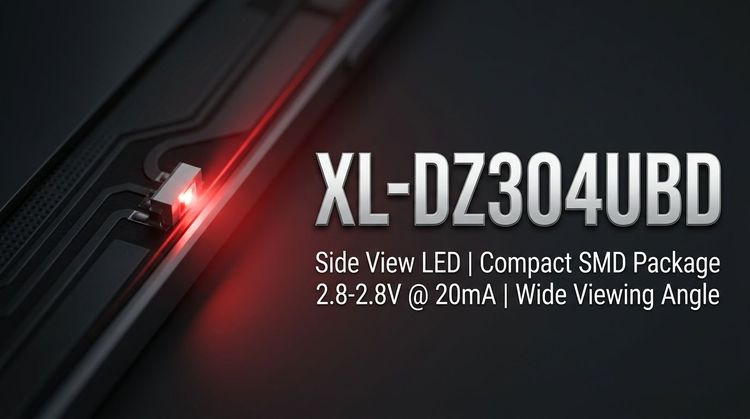
The XL-DZ304UBD is a standard 3mm blue indicator lamp from XINGLIGHT, featuring a blue colloid lens and a compact radial leaded package. 💡 This component is engineered to provide clear visual status indication in IoT devices and medical instrumentation, offering a balance between luminous intensity and power consumption. Its design prioritizes ease of integration into PCBs requiring automated through-hole assembly (THT). 🛠️ The focus here is on delivering stable optical performance within a standard operating temperature range of -40°C to +85°C.
🔌 Typical Applications
Based on its robust environmental testing status and electrical characteristics, the XL-DZ304UBD is suited for the following specific applications:
- IoT & Connectivity: Status indicators for converters and communication modules.
- Data Infrastructure: Signal lights for storage servers and network equipment.
- Medical Devices: Power or operation indicators meeting general medical equipment standards.
- Test & Measurement: Visual feedback for electronic testing instruments.
- Consumer Electronics: General purpose pilot lights and front panel displays.
⚡ Key Technical Specifications
The optical performance of the XL-DZ304UBD is categorized into specific brightness and voltage bins to ensure consistency. Below are the typical electro-optical characteristics at $T_a=25^\circ\text{C}$:
| Parameter | Symbol | Min | Typ. | Max | Unit | Conditions |
|---|---|---|---|---|---|---|
| Luminous Intensity | $I_V$ | 300 | - | 900 | mcd | $I_F=20\text{mA}$ |
| Dominant Wavelength | $\lambda_d$ | 460 | - | 470 | nm | $I_F=20\text{mA}$ |
| Peak Wavelength | $\lambda_p$ | - | 465 | - | nm | $I_F=20\text{mA}$ |
| Forward Voltage | $V_F$ | 2.8 | - | 3.6 | V | $I_F=20\text{mA}$ |
| Reverse Current | $I_R$ | - | - | $\le 1$ | $\mu\text{A}$ | $V_R=5\text{V}$ |
| Viewing Angle | $2\theta_{1/2}$ | - | 45 | - | deg | $I_F=20\text{mA}$ |
Note on Binning:
- Brightness: Bins A4 (300-400mcd) through A7 (700-900mcd).
- Voltage: Bins N13-3 (2.8V) through N13-6 (3.4V).
- Color: HB04 (460-465nm) and HR05 (465-470nm).
⚠️ Absolute Maximum Ratings & Process Limits
Exceeding these ratings may cause device failure or permanent degradation. 📉 These limits are critical for designing protective circuits and ensuring long-term reliability in harsh environments.
| Parameter | Symbol | Max | Unit |
|---|---|---|---|
| Power Dissipation | $P_D$ | 75 | mW |
| Continuous Forward Current | $I_F$ | 20 | mA |
| Peak Forward Current | $I_{FP}$ | 80 | mA |
| Reverse Voltage | $V_R$ | 5 | V |
| ESD Tolerance | ESD | 2000 | V |
| Operating Temperature | $T_{OPR}$ | -40 ~ +85 | $^\circ\text{C}$ |
| Storage Temperature | $T_{STR}$ | -40 ~ +85 | $^\circ\text{C}$ |
| Soldering Temp/Time | $T_{SOL}$ | 260 | $^\circ\text{C}/6\text{S}$ |
⚠️ Design Insight: The device is rated at Moisture Sensitivity Level (MSL) 2, requiring floor life management to avoid pop-corning during reflow.
📦 Package, Dimensions & Assembly Notes
The XL-DZ304UBD utilizes a standard molded epoxy package suitable for vertical mounting on PCBs.
- Appearance Dimensions: 7.5mm (Height) $\times$ 6.5mm (Diameter/Width) $\times$ 4.5mm (Depth).
- Tolerances: $\pm 0.25\text{mm}$ unless otherwise noted.
- Soldering: Designed to withstand standard lead soldering profiles ($260^\circ\text{C}$ for $\le 6$ seconds).
- Packaging: ESD-safe, moisture-proof foil bags (EIA standard).
🏭 Sourcing & Supply Considerations
- Sample Availability: Request specific bin codes (e.g., A7/N13-4) to match prototype brightness and voltage requirements.
- Shelf Life: MSL 2 classification means components must be mounted within 1 year of opening the sealed bag, or baked prior to use.
- BOM Management: Verify color binning (HB04/HR05) if visual uniformity across multiple LEDs is a critical design factor.
❓ Frequently Asked Questions
Q: What is the recommended current for this LED to achieve maximum life?
A: While the Absolute Maximum Current is 20mA, it is standard engineering practice to drive the LED at 15-18mA. This slight derating significantly reduces heat generation and extends the operational life, especially in high-ambient temperature environments like server enclosures.
Q: Can I solder this LED using a wave soldering process?
A: Yes, as a through-hole component, the XL-DZ304UBD is compatible with wave soldering. However, ensure the solder temperature does not exceed 260°C and contact time is minimized to under 6 seconds to prevent damage to the epoxy lens or internal bond wires.
Q: What does the "Blue Colloid" specification mean for my design?
A: The "Blue Colloid" refers to the tinted epoxy resin used to encapsulate the die. This acts as a color filter, ensuring high contrast and purity of the blue light (460-470nm). It also diffuses the light slightly, contributing to the 45-degree viewing angle.
Q: How strict is the 2000V ESD rating?
A: A 2000V rating (Human Body Model) is standard for many industrial LEDs, but it is relatively low compared to ESD-protected logic chips. During assembly, ensure workstations are grounded and operators wear wrist straps. Incorporating a current-limiting resistor is the standard protection method.
Q: Are there specific storage conditions to maintain warranty validity?
A: Yes. The datasheet specifies storage at temperatures not exceeding 30°C and relative humidity not exceeding 70%. If the components are stored outside these ranges or for longer than 3 months without nitrogen or desiccants, you must perform a "bake-out" before soldering to prevent moisture damage.