📌 Product Overview
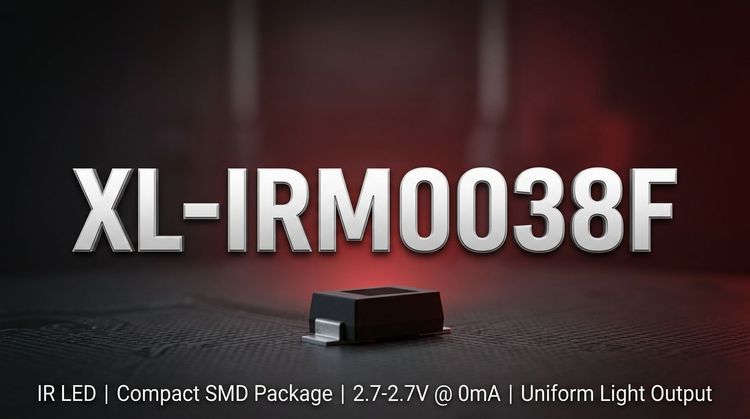
The XL-IRM0038F is a dedicated infrared receiver head designed for remote control systems, combining a high-sensitivity PIN photodiode with a high-gain, low-power preamplifier IC. 🏗️ Its design emphasizes signal integrity through an internal and external dual-shielding structure, which effectively mitigates environmental electromagnetic interference.
💡 Targeted at appliances, multimedia devices, and industrial controls, the module supports a wide operating voltage range of 2.7V to 5.5V. It features a semi-circular spherical epoxy package that optimizes reception angles while ensuring compatibility with standard TTL and CMOS logic levels.
🔌 Typical Applications
- Consumer Appliances: Integration into air conditioners, fans, heaters, and humidifiers for non-contact UI control.
- Multimedia Systems: Signal reception for TVs, DVD players, set-top boxes, and vehicle-mounted mobile DVD units.
- Industrial & Peripherals: Usage in instrumentation, industrial automation, and computer peripheral sensing.
- Specialty Electronics: Suitable for remote control toys, sanitary ware sensors, and automotive lighting electronics.
⚙️ Key Technical Specifications
| Parameter | Symbol | Min. | Typ. | Max. | Unit | Conditions |
|---|---|---|---|---|---|---|
| Supply Voltage | VDD | 2.7 | - | 5.5 | V | Recommended |
| Carrier Frequency | f₀ | - | 37.9 | - | kHz | - |
| Working Current | Icc | 0.3 | 0.53 | 0.7 | mA | VDD=5V |
| Reception Distance | L | 12 | 15 | 18 | m | 0° angle |
| Low Level Output | Vol | - | 0.2 | 0.4 | V | Isink=2.0mA |
| High Level Output | Voh | 4.8 | - | 5.0 | V | - |
💡 The module operates with a typical transmission carrier of 37.9 kHz and maintains low power consumption, making it suitable for battery-operated remote controls.
⚠️ Absolute Maximum Ratings & Process Limits
| Parameter | Symbol | Rating | Unit |
|---|---|---|---|
| Supply Voltage | VDD | 6.0 | V |
| Operating Temp. | Topr | -20 to +85 | °C |
| Storage Temp. | Tstg | -40 to +125 | °C |
| Wave Soldering | Tsol | 260, ≦6s | °C |
| Manual Welding | Tsol | 300, 3s | °C |
🔒 Exceeding these limits risks permanent damage to the internal PIN diode and amplifier IC. Strict adherence to the soldering profiles is necessary to prevent degradation of the epoxy encapsulation and shield performance.
📦 Package, Dimensions & Assembly Notes
- Package Type: Epoxy resin plastic encapsulated, semi-circular spherical design.
- Dimensions (L×W×H): 12.5 mm × 10 mm × 5.6 mm.
- Pin Length: 16 mm.
- Design Feature: The module includes a semi-spherical lens to widen the reception angle and features dual shielding to resist side-light interference.
💡 When designing the PCB footprint, ensure the 16mm pin length is accommodated or trimmed appropriately to fit the housing assembly. The compact volume allows for high-density mounting on the front panel of devices.
🚀 Sourcing & Supply Considerations
- Compliance: The XL-IRM0038F is REACH and ROHS certified, meeting strict environmental standards for global distribution.
- Supply Chain: Verify authenticity to ensure the dual-shielding construction meets the datasheet specifications for immunity.
- Sampling: Request samples for testing specific transmission distances in your ambient light conditions.
❓ FAQ
Q: What is the standard carrier frequency for the XL-IRM0038F?
A: The typical center frequency is 37.9 kHz with a Band Pass Filter (BPF) width of 5.0 kHz.
Q: How does the dual-shielding design benefit the application?
A: It provides internal and external anti-interference capabilities, allowing the receiver to withstand environmental noise from fluorescent lamps or other IR sources.
Q: What are the limits for soldering this component?
A: For wave soldering, do not exceed 260°C for 6 seconds; for manual welding, do not exceed 300°C for 3 seconds.
Q: Is the output compatible with 3.3V logic?
A: Yes, the wide supply voltage range (2.7V–5.5V) ensures compatibility with both 3.3V and 5V TTL/CMOS logic levels.
Q: What is the reception distance at an angle?
A: At 35 degrees (left or right), the reception distance is typically reduced to 8–10 meters, compared to 15 meters at 0 degrees.
Q: Can this be used in automotive environments?
A: Yes, the operating temperature range of -20°C to +85°C allows for use in internal cabin automotive electronics like DVD players or lighting controls.