📌 Product Overview
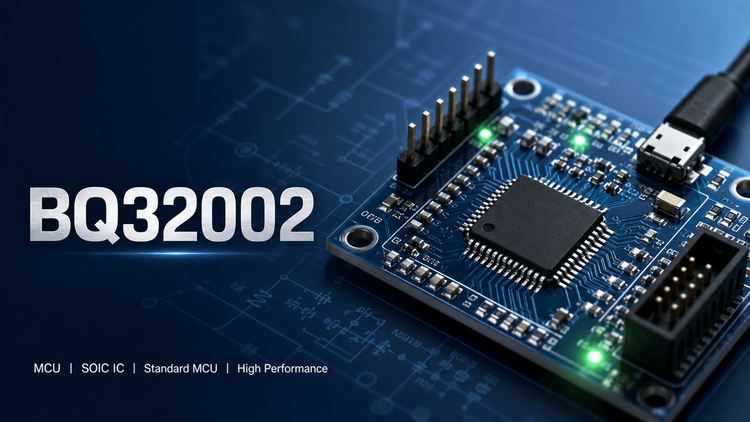
The BQ32002 is a 3.3V real-time clock (RTC) designed for precision timekeeping in embedded systems. It replaces industry-standard RTCs with an upgrade in integration, featuring I2C communication up to 400kHz and automatic backup supply switching. For engineering teams, the critical selection variables are the integrated oscillator fail detection and the programmable calibration register (±63 ppm to +126 ppm), which significantly reduce drift in consumer electronics without manual intervention. This component is ideal for systems requiring reliable time retention during main power failure.
🎯 Typical Applications & Design Context
This device fits best in general consumer electronics (smart meters, set-top boxes, appliance UI panels) where bill-of-materials (BOM) cost and board space are constrained.
- I2C Bus Interfacing: Simplifies integration with standard MCUs, reducing GPIO overhead compared to parallel interfaces.
- Backup Power Flexibility: Supports both non-rechargeable batteries and supercapacitors (via trickle charge management logic removed in Rev B, requires external design check).
- Oscillator Health Monitoring: The Oscillator Fail (OF) flag is critical for mission-critical logging, alerting the host system if the 32.768kHz crystal stops functioning, preventing "frozen time" data corruption.
📊 Key Technical Specifications
| Parameter | Specification | Engineering Note |
|---|---|---|
| Supply Voltage (VCC) | 3.0 V to 3.6 V | Tighter range than generic 5V RTCs; requires strict 3.3V rail control. |
| Interface | I2C (up to 400 kHz) | Supports Fast-Mode; reduce pull-up strength if power consumption is critical during backup. |
| Temperature Range | –40°C to +85°C | Standard commercial/industrial range; derating crystal aging is required for high-temp environments. |
| Calibration Range | –63 ppm to +126 ppm | Digitally adjusts for crystal tolerance; essential for maintaining accuracy across thermal gradients. |
| Crystal Load (CL) | 12 pF | External crystal matching is mandatory for timekeeping accuracy. |
⚠️ Absolute Maximum Ratings & Process Limits
Exceeding these ratings invites immediate latent failure or "soft errors" in time registers.
| Parameter | Value | Failure Mode / E-E-A-T Insight |
|---|---|---|
| Voltage on VCC | –0.3 V to 4.0 V | ⚠️ Latch-up Risk: Exceeding 4V (even briefly during ESD or hot-swap) can trigger CMOS latch-up, causing catastrophic thermal failure. |
| Input Voltage (Any Pin) | –0.3 V to VCC + 0.3 V | 🔒 IO Tolerance: Do not drive SDA/SCL with 5V logic levels without level shifters. |
| Tj (Junction Temp) | –40°C to 150°C | ✨ Reflow Warning: Internal junction temperature during SMT reflow must stay below 150°C to prevent bond wire damage. |
| Crystal ESR | Max 70 kΩ | 💡 Start-up Failure: High ESR (Equivalent Series Resistance) crystals are the #1 cause of RTC time failure. Ensure crystal spec < 40kΩ for margin. |
🧩 Package, Dimensions & Assembly Notes
- Package: 8-Pin SOIC (Small Outline Integrated Circuit).
- Body Size: 4.90 mm × 3.91 mm (Nominal).
- MSL (Moisture Sensitivity): Likely Level 3 (standard for SOIC), but verify specific packing date code. If floor life > 168 hours is exceeded, baking (125°C for 24h) is mandatory to prevent popcorn cracking during reflow.
- Soldering: Standard reflow profiles apply. Ensure OSCI/OSCO traces are short and guarded to prevent noise coupling from switching power supplies, which can cause RTC "glitches" or oscillator stalling.
🔍 Procurement & Sourcing Insights
💡 Supply Chain Reality:
- Lifecycle Status: Check the "Buy Documents" tab. If marked "NRND" (Not Recommended for New Design), procure sufficient lifetime stock immediately.
- Alternative Validation: Replacing standard RTCs (like Epson RX-8035) with BQ32002 requires firmware updates due to differing Register Map structures. The "Trickle Charge" pump was removed in Revision B; verify if your legacy design relies on this feature.
- Risk Control: In the Huaqiangbei spot market, clean reclaimed SOIC-8 chips are common. Traceability and anti-counterfeit scanning (checking package laser mark consistency) are vital to avoid remarked devices with failed internal oscillators.
❓ FAQ
Q: Can I use a 5V crystal driver with the BQ32002?
A: No. The BQ32002 is strictly a 3V (3.0-3.6V) device. Connecting a 5V crystal or driving the I2C lines at 5V will violate the Absolute Maximum Ratings and likely damage the input protection diodes.
Q: How do I solve the "Oscillator Fail" (OF) flag issue in production?
A: The OF flag indicates the amplitude of the crystal oscillation is too low. This is usually caused by using a crystal with ESR > 70kΩ or incorrect Load Capacitance (CL). Always select a crystal specifically tuned for 12pF with low ESR (typically < 30kΩ recommended).
Q: Is the BQ32002 a drop-in replacement for the older BQ32000?
A: Mostly, but verify the Trickle Charger function. The BQ32002 (Rev B) removed the internal trickle charger circuit seen in older siblings. If your design uses a supercapacitor requiring charging, you must add external charging components or switch to a rechargeable battery backup solution.
Q: Why is my RTC drifting 5 seconds per day?
A: This is typically a crystal calibration issue. The BQ32002 allows a ±63 ppm calibration adjustment. You can write to the calibration register in software to compensate for the crystal's initial tolerance error.