📌 Product Overview
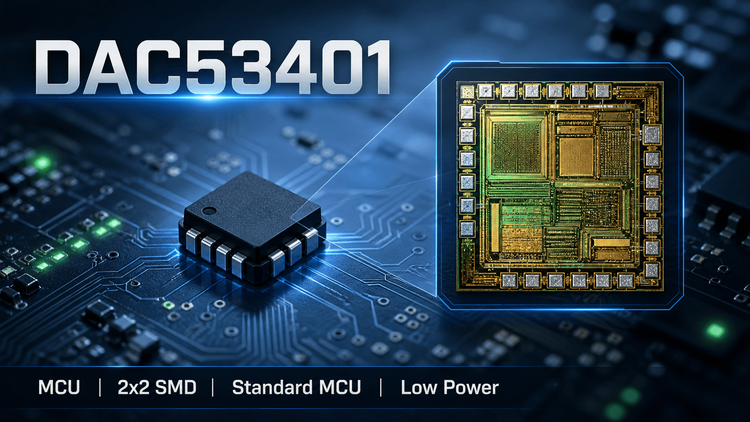
The DAC53401 is a 10-bit, voltage-output Digital-to-Analog Converter (DAC) featuring integrated nonvolatile memory (NVM) and a PMBus™ compatible I2C interface. Targeting power supply margining, bias generation, and optical control in compact systems, this component eliminates the need for external EEPROM by storing register settings internally. It operates from 1.8 V to 5.5 V and fits into an ultra-compact 2 mm × 2 mm WSON package, making it ideal for space-constrained PCBs like mobile modules and rack servers. Engineers primarily select this part for its internal reference stability and power-on configurability without MCU intervention.
🎯 Typical Applications & Design Context
💡 Rack Servers & Power Sequencing: Used for voltage margining and dynamic power supply control via the feedback pin (FB) to adjust output voltages.
🚑 Medical Devices: Features pre-programmed medical alarm tone generation (low/medium/high priority), reducing firmware overhead for patient monitoring systems.
📡 Active Antenna & Automotive: Supports general-purpose bias control and USB charging port adjustments in automotive infotainment.
💡 Why it fits: The tiny footprint (2mm²) and low power consumption (0.2 mA) suit high-density arrays, while the slew rate control prevents inrush current issues during voltage transitions.
📊 Key Technical Specifications
| Parameter | Specification | Notes |
|---|---|---|
| Resolution | 10-bit | DAC53401 (8-bit for DAC43401) |
| Output Voltage Range | 1.8 V to 5.5 V | Scalable with supply voltage |
| Interface | I2C (PMBus™ compatible) | Supports Standard, Fast, Fast+ modes |
| Internal Reference | Integrated | Selectable or Supply-as-Reference |
| Active Current | 0.2 mA @ 1.8 V | Ultra-low power for battery ops |
| Nonvolatile Memory | 128 bits (NVM/EEPROM) | Auto-recall on power-up |
⚠️ Absolute Maximum Ratings & Process Limits
| Parameter | Rating | Failure Mechanism / Note |
|---|---|---|
| Supply Voltage (VDD) | –0.3 V to +6.0 V | Exceeding 6V may cause permanent oxide breakdown of the input transistors. |
| Input Current (Any Pin) | ±50 mA | > 🔒 Latch-up Risk: Exceeding current flow into I/O pins can trigger CMOS latch-up, destroying the chip. |
| Total Power Dissipation | Internally limited | Thermal Warning: In the 2x2 WSON package, high drive currents raise junction temps rapidly; ensure PCB copper acts as a heatsink. |
| ESD Rating | 2 kV (HBM) | ⚡ Handling Risk: Despite robustness, improper grounding during assembly can zap the I2C pins. |
| Operating Temp | –40°C to +125°C | Performance drift (Gain/Error) must be derated above 85°C for precision applications. |
E-E-A-T Insight: The 2x2mm WSON package has a low thermal mass. 🔥 SMT Risk: During reflow, if the thermal profile exceeds 260°C or time-above-liquidus is too long, the internal LDO or NVM reliability degrades.
🧩 Package, Dimensions & Assembly Notes
- Package Type: 8-pin WSON (2.00 mm × 2.00 mm).
- Key Dimensions: The thermal pad (if present, or pin arrangement) requires careful stencil design.
- SMT Assembly:
- CAP Pin Stability: Pin 4 (CAP) requires an external capacitor (0.5µF to 15µF) to AGND. Missing this cap causes internal LDO oscillation, leading to unstable analog output.
- Stencil Design: Due to the tiny footprint, aperture reduction is recommended for the thermal pad to prevent solder wicking or tombstoning.
- Inspection: X-ray inspection is recommended to verify solder joints under the pins, as visual inspection is difficult on 2mm pitch.
🔍 Procurement & Sourcing Insights
- Lead Time Variability: As a specialized logic/analog hybrid, lead times can extend to 20+ weeks during shortages.
- Alternative Risk: While the DAC43401 (8-bit) is pin-compatible, swapping to the DAC53401 (10-bit) requires firmware register updates for resolution scaling.
- Counterfeit Alert: Verify traceability codes; remarked parts from the open market often have defective NVM blocks that fail "Save/Recall" tests.
- Supply Chain Tip: LDeepAI recommends validating the A0 address pin logic on samples, as incorrect addressing leads to I2C bus collisions in multi-DAC arrays.
❓ FAQ
Q: Can I use the DAC53401 to directly drive a power MOSFET gate?
A: No. The output is a buffered voltage reference, not a high-current driver. It can drive the MOSFET's gate charge indirectly but requires an external gate driver buffer to handle the peak current required for fast switching.
Q: What is the difference between using the Internal Reference vs. VDD as Reference?
A: Using VDD as a reference means the DAC output scales with your supply voltage (ratiometric), which is noisy. Using the Internal Reference provides a stable, fixed output voltage regardless of VDD fluctuations, which is critical for calibration or sensor bias.
Q: Does the NVM (EEPROM) wear out after frequent writes?
A: Yes. The NVM is rated for a specific number of write/erase cycles (typically 50k+). For applications requiring constant waveform updates (like high-speed PWM), use the volatile registers and only write to NVM when storing the final "power-up default" configuration.
Q: How critical is the capacitor on the CAP pin?
A: It is mandatory. The CAP pin stabilizes an internal LDO. Without a 0.5µF+ capacitor placed very close to the pin, the DAC output will exhibit significant noise and oscillation, rendering the 10-bit precision useless.
Q: How do I handle the tiny 2x2mm WSON package in manual prototyping?
A: Manual soldering is extremely difficult. For validation, use a specialized evaluation module (EVM) or a breakout adapter board. For mass production, ensure your PCB supports the appropriate thermal pad relief and solder mask defined (SMD) pads.