📌 Product Overview
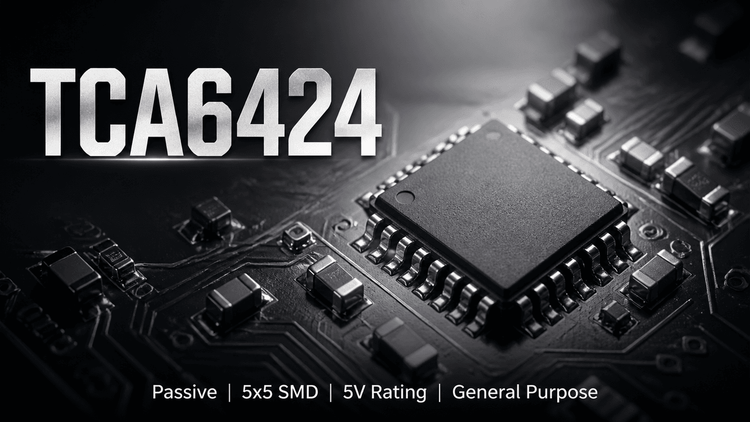
The TCA6424 is a 24-bit General Purpose Input/Output (GPIO) expander utilizing the I²C/SMBus interface. It is designed to extend the I/O limitations of microcontrollers (MCUs) where pin count or voltage domains are constraints.
🔍 Engineering Perspective: While marketed under International Rectifier, this datasheet (SCPS175B) refers to Texas Instruments (TI) architecture. The most critical attribute is its dual-supply capability, allowing bidirectional voltage level translation between the MCU bus (VCCI) and the peripheral port (VCCP). However, the "Not Recommended for New Designs" (NRND) status is the defining factor for procurement, signaling that design teams should prioritize migration strategies rather than long-term reliance.
🎯 Typical Applications & Design Context
- Multi-Voltage System Design: Ideal for interfacing legacy 5V peripherals (e.g., sensors, LEDs) with modern low-voltage (1.8V/2.5V) MCUs without needing external level shifters.
- GPIO Expansion: Adding auxiliary control lines (reset enables, power enables) or indicator LEDs in space-constrained PCBs.
- Industrial Control: Utilizing the interrupt feature (INT) to poll button presses or alarm signals from remote sensors without constant I²C bus polling.
💡 Why this component? Its wide VCC range (1.65–5.5V) on both ports simplifies BOM logistics by removing the need for specific voltage-compatible translators.
📊 Key Technical Specifications
| Parameter | Specification | Engineering Note |
|---|---|---|
| Supply Voltage Range | 1.65 V to 5.5 V | Supports operation on both VCCI (I²C side) and VCCP (Port side). |
| I/O Count | 24 Bits | Configurable as Input or Output via I²C registers. |
| I²C Speed | Up to 400 kHz (Fast-Mode) | Adequate for control tasks; not suitable for high-speed data transfer. |
| Interrupt Output | Open-Drain, Active-Low | Allows asynchronous reporting of input state changes to the host. |
| Reset Input | Active-Low (RESET) | Allows hardware resetting of the device without power cycling. |
| Polarity Inversion | Yes | Can invert logic polarity of input registers via software command. |
⚠️ Absolute Maximum Ratings & Process Limits
| Rating | Value | Failure Consequence |
|---|---|---|
| Supply Voltage (VCCI/VCCP) | –0.5 V to 6.0 V | Exceeding 6.0V risks permanent oxide breakdown of the CMOS structure. |
| Input Current | ±20 mA | Latch-up risk or bonding wire fusing if current injection occurs during ESD or mismatch. |
| Total Current | ±100 mA | Exceeding package power dissipation limits causes thermal runaway. |
| Operating Temperature | –40°C to 125°C | Beyond this range, timing parameters violate I²C spec. |
🚨 Critical Validation Insight: While the datasheet highlights voltage translation, engineers must validate the Rise Time (tr) and Fall Time (tf). If the pull-up resistors on the I²C bus are too weak (high value), the slow rise time may violate the Schmitt Trigger input thresholds, leading to communication glitches, especially at 400 kHz.
🧩 Package, Dimensions & Assembly Notes
- Package Type: UQFN-32 (RGJ) / 5.00 mm × 5.00 mm
- Pitch: 0.50 mm
- Soldering: The exposed thermal pad (if present in center, though Pin 25 is GND) requires specific attention during reflow.
🏭 SMT Manufacturing Guide:
- Stencil Design: For the 5x5mm UQFN, ensure stencil aperture reduction is optimized for 0.5mm pitch to prevent bridging.
- Thermal Relief: The ground pins (Pin 25) act as the primary thermal path. Ensure proper thermal pad definition in the PCB land pattern to dissipate heat during operation, especially when driving multiple LEDs at 25mA per I/O.
- Handling: Moisture Sensitivity Level (MSL) is likely 3 (standard for this form factor). If the dry pack is broken, baking is required to prevent popcorning during reflow.
🔍 Procurement & Sourcing Insights
- Lifecycle Status:NRND (Not Recommended for New Designs). This is the most critical procurement data point. TI may have issued a "Product Change Notification" (PCN) or "End of Life" (EOL) notice subsequent to this revision.
- Sourcing Strategy: Do not design this into new long-life products (industrial/medical) without a backup plan.
- Alternatives: Search for direct replacements like the TCA6408 (8-bit) or TCA6416 (16-bit) as fallbacks, or migrate to TI’s newer "A" versions if available (e.g., TCA9539).
- Authenticity: As the part phases out, the risk of refurbished or counterfeit material in the Huaqiangbei supply chain increases. Always verify traces and packaging date codes.
💡 LDeepAI Expert Tip: If you face allocation, checking the ADDR pin logic is crucial. The TCA6424 allows up to two devices on the bus. Ensure your hardware pull-up/pull-down on the ADDR pin matches the software driver expectation to avoid bus collisions during debug.
❓ FAQ
Q: Can the TCA6424 replace the older PCF8575?
A: Not directly. While both are I²C expanders, the register maps are different. The TCA6424 requires specific command byte protocols to read Input Ports vs. Output Ports. A full driver rewrite is required for migration.
Q: What happens if VCCI and VCCP are powered up at different times?
A: The datasheet specifies "No Glitch On Power Up" regarding I/O states. However, for level translation to work correctly, VCCI must be powered before or simultaneously with VCCP. If the I²C bus (VCCI) is unpowered while the Port side (VCCP) is active, the IC may not correctly clamp the bus voltage, potentially leaking current into the MCU's I²C pins.
Q: My I²C bus is 3.3V, but my LED needs 5V. How do I configure the hardware?
A: Set VCCI = 3.3V and VCCP = 5V. The TCA6424 will translate the I²C logic levels up to the port side. Ensure the P-Port is configured as Push-Pull output to drive the LED, and calculate the current limit resistor based on the LED's forward voltage and the 5V supply.
Q: Is the INT pin level-sensitive or edge-sensitive?
A: The INT output is Active-Low Open-Drain. It holds low (asserts) as long as there is a mismatch between the actual input pin state and the Input Port register. The host MCU must read the port (via I²C) to clear the interrupt condition and reset the INT pin to High (through its pull-up resistor).