📌 Product Overview
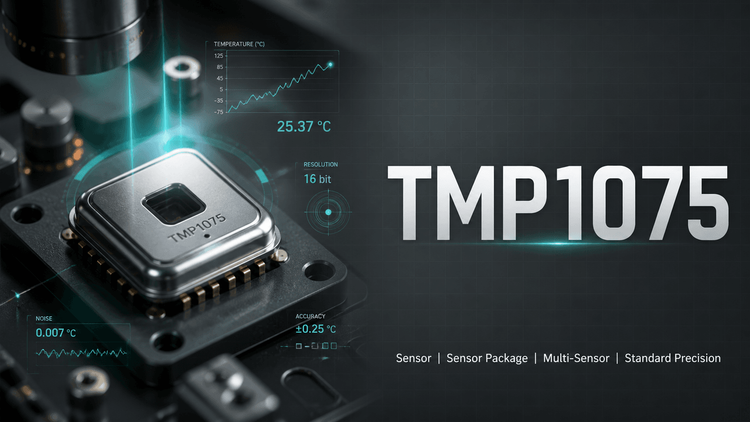
The TMP1075 is a digital temperature sensor designed as a high-precision, low-power upgrade for the industry-standard LM75 and TMP75 families. Utilizing an I²C and SMBus interface, it provides 12-bit resolution (0.0625°C) and is typically accurate to ±0.25°C. 💡
For OEMs and EMS providers, this component is a strategic "drop-in" replacement for legacy designs, offering pin-to-pin compatibility in standard packages (SOIC-8, VSSOP-8) while introducing smaller form factors (WSON-8, SOT563-6) for space-constrained applications like mobile devices and IoT nodes. 🚀
🎯 Typical Applications & Design Context
This sensor is engineered for environments where power efficiency and board space are critical.
- Enterprise Computing & Servers: Ideal for monitoring CPU, GPU, and memory temperatures due to its high accuracy and SMBus Alert function.
- Battery Management: The ultra-low shutdown current (0.37μA) makes it suitable for portable electronics where battery drain must be minimized.
- Industrial & HVAC:NIST traceability ensures reliable performance in thermostats and environmental sensors requiring calibrated data logging.
📊 Key Technical Specifications
| Parameter | Condition/Value | Engineering Impact |
|---|---|---|
| Temperature Accuracy | ±0.25°C (Typ), ±1°C (Max) | High precision enables tighter thermal throttling control in MCUs. |
| Interface Protocol | I²C / SMBus | Supports up to 32 addresses (standard version), enabling multi-point sensing on a single bus. |
| Supply Voltage | 1.7V to 5.5V (Standard) | Allows direct integration into both 3.3V and 5V systems without level shifters. |
| Active Current | 2.7μA (Average) | Essential for battery-powered designs; minimizes power budget impact. |
| Resolution | 12-bit (0.0625°C) | Detects minute thermal changes before they escalate into system failures. |
⚠️ Absolute Maximum Ratings & Process Limits
Exceeding these boundaries risks permanent silicon damage or latent field failures.
| Parameter | Rating | Failure Mode / Risk |
|---|---|---|
| Supply Voltage ($V_{+}$) | -0.3V to 6.0V | Exceeding 6.0V can cause immediate oxide breakdown of the input pins. |
| Operating Temp Range | -55°C to 125°C (Std) | While accurate, operation near limits requires verifying the specific package derating curve. |
| ESD Rating (HBM) | 2000V | Standard handling; during SMT, improper grounding can lead to latent defects causing "infant mortality." |
| Soldering (Max Time) | 260°C for <40s | Exceeding reflow peak time can delaminate the internal die attach, especially in WSON/DFN packages. |
⚠️ E-E-A-T Insight: Do not overlook the N version (TMP1075N) voltage limits (1.62V - 3.6V). Accidental application of 5V to the "N" variant will destroy the IC. Ensure strict segregation of reels in the SMT line.
🧩 Package, Dimensions & Assembly Notes
The TMP1075 offers four package options to balance board space and thermal performance.
- SOIC (D) & VSSOP (DGK): Direct drop-in for existing LM75 footprints. No PCB changes required.
- WSON (DSG) & SOT563 (DRL):Footprint reduction of up to 89%. 🔒
- Assembly Note: The SOT563 (DRL) version uses a 6-pin pinout where address pins A1/A2 are removed and supply voltage is capped at 3.6V. Verify stencil aperture designs for the thermal pad on WSON packages to ensure proper solder voiding control during X-Ray inspection.
🔍 Procurement & Sourcing Insights
- Supply Chain Visibility: While "industry standard," TI sensors often face 20-30 week lead times during shortages. The TMP1075 offers 32 address options vs. competitors' typical 8, reducing the need to source multiple SKUs.
- Alternative Validation: When substituting for LM75/TMP75, verify the ALERT pin logic polarity. The TMP1075 defaults to specific Comparator mode settings that may differ from older generations.
- Anti-Counterfeit: Given the NIST traceability claim, distributors must provide a valid Certificate of Conformity (CoC). 🚀 "Too cheap" sensors often omit the internal trimming required for ±0.25°C accuracy.
❓ FAQ
Q: Can I directly replace an LM75 with TMP1075 on my existing PCB?
A: Yes, if you are using the SOIC-8 (D) or VSSOP-8 (DGK) packages. They share identical pinouts. However, for WSON or SOT563, the footprint is different and requires a PCB layout update.
Q: What is the risk of mixing TMP1075 and TMP1075N on the same BOM?
A: Critical Failure. The TMP1075N supports a lower voltage range (max 3.6V) and only 4 I2C addresses. Using the "N" variant in a 5V system or a complex bus will result in device failure or communication collisions.
Q: How does the "NIST Traceability" affect my production yield?
A: It implies the device was tested against NIST-traceable equipment. For medical or high-reliability industrial devices, this reduces the need for individual system calibration, potentially lowering your test station capital expenditure (CapEx).
Q: Are there hidden costs in the SOT563 package conversion?
A: The SOT563 (DRL) is 1.6mm x 1.6mm. While saving space, it requires finer pitch stencils and more advanced pick-and-place nozzles. Ensure your EMS provider has verified their placement capability for this small body size to avoid stoppage during pilot runs.