📌 Product Overview
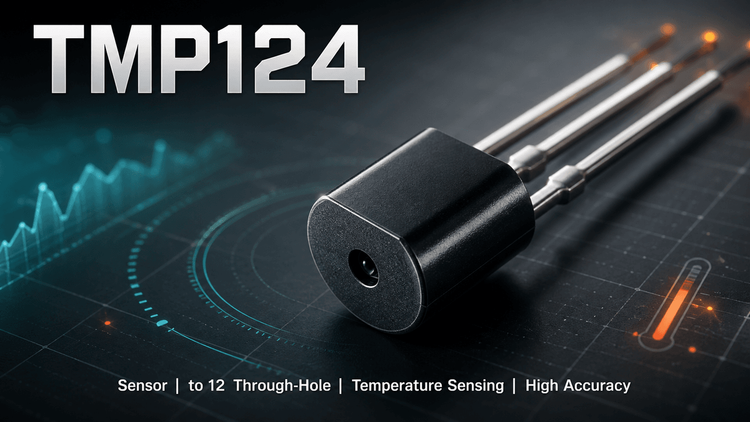
The Texas Instruments TMP124 is a high-precision, SPI-compatible digital temperature sensor designed for industrial and automotive-grade thermal monitoring. Unlike standard analog sensors, the TMP124 utilizes a Sigma-Delta analog-to-digital converter to deliver temperature data digitally, eliminating signal degradation over long PCB traces. Its core value lies in the combination of ±1.5°C accuracy and ultra-low power consumption (50 µA), making it an ideal solution for battery management systems (BMS), industrial PLCs, and compute nodes where power budget and thermal reliability are critical constraints for engineers.
🎯 Typical Applications & Design Context
- Battery Management Systems (BMS): 💡 The low quiescent current (50 µA) minimizes drain on battery packs, while the wide operating range supports critical temperature monitoring during charging cycles.
- Industrial Automation & HVAC: Designed for harsh environments, the device operates reliably up to +150°C (operation), suiting it for motor drives or boiler controls where ambient heat exceeds standard IC limits.
- Computing & Peripherals: The SPI interface allows high-speed daisy-chaining of multiple sensors (e.g., monitoring CPU, GPU, and memory) without occupying numerous I2C addresses, simplifying board layout in dense servers.
📊 Key Technical Specifications
| Parameter | Specification | Notes |
|---|---|---|
| Temperature Range | –40°C to +125°C (Specified) | Operates up to 150°C for short-term thermal excursions. |
| Accuracy | ±1.5°C (Max) | ±0.5°C typical at room temp. 🚀 Tight tolerance ensures reliable fan triggering. |
| Interface | SPI™ | Supports daisy-chain mode (multiplexing). |
| Resolution | 9 to 12 bits (Configurable) | Programmable trade-off between conversion speed and precision. |
| Supply Voltage | 2.7V to 5.5V | Compatible with both 3.3V and 5V logic systems. |
| Conversion Time | 0.04s to 0.32s | Depends on selected resolution (9-bit to 12-bit). |
⚠️ Absolute Maximum Ratings & Process Limits
| Parameter | Rating | E-E-A-T Engineering Insight |
|---|---|---|
| Supply Voltage (V+) | 7.0V (Max) | Exceeding 7V risks immediate oxide breakdown of the CMOS structure. |
| Input Current | 10mA | Current limiting is required if the SPI lines are exposed to external ESD surges. |
| Junction Temp (Tj) | +150°C | 🚫 Critical Failure Point: Continuous operation near or above this threshold shifts the silicon bandgap, causing permanent calibration drift (sensor "lies" about temperature) even if the package survives physically. |
| Soldering (Lead) | 300°C | Standard reflow profiles are safe, but prolonged manual soldering can degrade the internal die attach. |
🧩 Package, Dimensions & Assembly Notes
The TMP124 is available in the SO-8 (D) package, distinct from the TMP122 which uses SOT23-6.
- Footprint Verification: 👇 Ensure your PCB library accommodates the 1.27mm pitch of the SO-8 package. Mixing up TMP122 and TMP124 footprints is a common assembly error.
- Thermal Path: The SO-8 package has a thermal resistance (θJA) of 150°C/W. For accurate sensing, avoid placing the part directly over high-heat dissipating copper pours (like under a FET) unless measuring that specific hotspot; otherwise, conducted heat may skew ambient readings.
- SMT Assembly: Standard IR reflow or vapor phase soldering applies. No special underfill is required, but moisture sensitivity levels (MSL) should be checked for floor life if stored in high-humidity environments.
🔍 Procurement & Sourcing Insights
- Supply Chain Risk: As a legacy TI part (originally released 2003), lead times can fluctuate. 🚀 Do not rely solely on spot market inventory for new designs.
- Alternative Evaluation: When validating alternatives (e.g., from Maxim Integrated or Microchip), verify the SPI command set. While SPI is standard, the register mapping for Setpoints and Configuration often differs between vendors, requiring firmware changes.
- Traceability: For automotive or industrial applications, insist on reels marked with TI's specific Date/Lot code to avoid refurbished or counterfeit material common in unauthorized channels.
- Design Tip: For volume procurement, the TMP124AIDR (Tape and Reel, 2500 units) is significantly more cost-effective for SMT compared to cut-tape versions, reducing handling time on the pick-and-place machine.
❓ FAQ
Q: Can I replace a TMP124 with a TMP122 without changing the PCB?
A: No. The TMP122 uses a SOT23-6 footprint, while the TMP124 uses an SO-8 footprint. They are pin-incompatible on the physical layout despite having identical electrical functionality.
Q: Does the TMP124 require an external crystal or clock source?
A: No. The device features an internal oscillator derived from the supply and sensor logic. It only requires the SPI clock (SCK) for data communication, simplifying the BOM.
Q: What is the risk of operating at the 150°C limit?
A: The datasheet specifies "Operation to 150°C," but parameters like Accuracy are only specified up to 125°C. Above 125°C, while the device may function, the ±2.0°C accuracy window is not guaranteed, posing a risk for thermal protection logic.
Q: How do I verify the authenticity of the part in the open market?
A: Check the package laser marking. The top mark must read "T124". Counterfeit parts often have inconsistent laser etching depth or font irregularities on the SO-8 package body.