📌 Product Overview
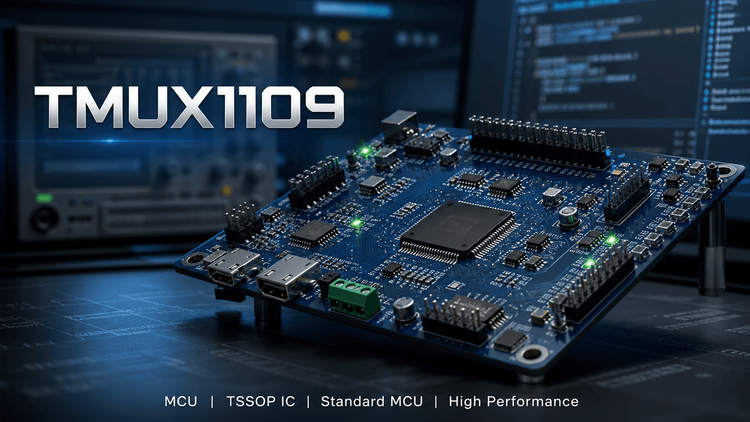
The TMUX1109 is a precision complementary metal-oxide semiconductor (CMOS) multiplexer (MUX) designed by Texas Instruments. It functions as a dual 4:1 (or differential 4:1) switch, specifically engineered to handle high-precision analog signal routing in systems where signal integrity is paramount.
Targeting critical applications such as ultrasound scanners, patient monitoring equipment, and industrial PLCs, this component excels in environments requiring minimal signal distortion. For engineering teams, the primary selection variables are the ultra-low leakage current (3pA) and low on-resistance ($R_{ON}$), which ensure accurate signal measurement without significant voltage droop or loading effects.
🎯 Typical Applications & Design Context
Based on the datasheet's electrical characteristics, the TMUX1109 is optimized for precision signal paths:
- Medical Imaging & Diagnostics: Ultrasound scanners and patient monitors leverage the low leakage and low charge injection to prevent signal artifacts in high-impedance sensor front-ends.
- Industrial Automation: Used in Analog Input Modules and PLCs where the wide temperature range (-40°C to +125°C) ensures reliability in harsh factory environments.
- Test & Measurement: ATE equipment utilizes the device’s break-before-make switching to prevent shorting during high-speed channel transitions.
This device fits these scenarios because it supports rail-to-rail operation and maintains precision across a wide supply voltage range (1.08V to 5.5V), making it versatile for both battery-powered portable devices and robust industrial backplanes.
📊 Key Technical Specifications
| Parameter | Value/Condition | Design Impact |
|---|---|---|
| Supply Range (Single) | 1.08 V to 5.5 V | 💡 Allows operation from low-voltage MCUs or standard 5V industrial rails. |
| Leakage Current ($I_{leak}$) | 3 pA (Max) | 🎯 Critical for high-impedance sensors (e.g., pH probes); ensures minimal signal error. |
| On-Resistance ($R_{ON}$) | 1.8 Ω (Typ) | 📉 Minimizes voltage drop across the switch, eliminating need for external compensation. |
| Charge Injection ($Q_{inj}$) | 1 pC | ✨ Reduces glitching in fast multiplexing applications, stabilizing ADC readings. |
| Logic Compatibility | 1.8 V Compatible | Ensures seamless interfacing with modern low-voltage FPGAs and MCUs. |
⚠️ Absolute Maximum Ratings & Process Limits
Exceeding these parameters risks permanent device failure or latent reliability issues in the field.
| Rating | Limit | E-E-A-T Failure Analysis |
|---|---|---|
| Supply Voltage ($V_{DD}$) | -0.5 V to 6.5 V | ⚡ Exceeding 6.5V can cause catastrophic oxide breakdown, leading to direct shorts between VDD and GND. |
| Input Current ($I_{IK}$) | ±20 mA | 🔒 High current on logic pins can melt metal traces or cause latch-up, severing the signal path. |
| Continuous Current ($I_{Sx/D}$) | ±20 mA | ⚠️ Overcurrent creates thermal stress on the bond wires, potentially causing open circuits after thermal cycling. |
| Operating Temp | -40°C to +125°C | 🌡️ While functional at 125°C, derating $R_{ON}$ is necessary; performance near the limit may accelerate aging. |
| ESD Rating (HBM) | 2000 V | ⚡ Improper handling during PCB assembly can zap the gate oxide, resulting in parametric failure (leakage increase). |
🧩 Package, Dimensions & Assembly Notes
The TMUX1109 is available in two thermally enhanced packages designed for space-constrained layouts:
- PW Package (TSSOP-16): 5.00 mm × 6.40 mm.
- Assembly Note: Standard SMT profile applies. Ensure adequate pad layout for the larger footprint to prevent tombstoning if thermal imbalance exists during reflow.
- RSV Package (QFN-16): 2.60 mm × 1.80 mm.
- Assembly Note: This package is highly sensitive to pad co-planarity. DO NOT use the reduction window for the thermal pad (exposed die pad) on the underside; insufficient solder paste on the center pad can lead to "floating" packages and thermal lift-off, causing intermittent connections. X-ray inspection is recommended for first article validation.
🔍 Procurement & Sourcing Insights
From a supply chain perspective, the TMUX1109 presents specific challenges and opportunities for OEM and EMS teams:
- Supply Voltage Risk: The 1.08V lower limit is aggressive. Generic "5V multiplexers" from competitors often fail at low voltages. Substituting with non-precision MUXes to save cost will result in signal drift at lower supply voltages.
- Availability Check: As a part of TI's "Precision Switches" family, this is not a high-volume commodity logic part. Lead times can fluctuate. When sourcing from open market (Huaqiangbei or independent distributors), beware of remarked devices. Verify the lot date code; older lots may have been stored in improper humidity (MSL > Floor life), affecting the 3pA leakage specification.
- Validation: Always procure samples for "A vs. B" validation. Measure leakage at 1.8V VDD to confirm the unit is genuine, as clones often fail the low-leakage test.
❓ FAQ
Q: Can I use the TMUX1109 to switch power rails?
A: No. While $R_{ON}$ is low (1.8Ω), this device is designed for signal integrity (precision analog), not power distribution. The maximum continuous current per channel is ±20mA. For power switching, use a dedicated Load Switch or Power MOSFET.
Q: What happens if I leave the Enable (EN) pin floating?
A: The datasheet specifies logic thresholds. Floating pins are susceptible to noise, which could cause unintended switching. To ensure the device remains off during microcontroller power-up or reset, connect a physical pull-down resistor (e.g., 100kΩ) to GND on the EN pin.
Q: Is the TMUX1109 pin-to-pin compatible with the standard 74HC4052?
A: Functionally similar in routing (Dual 4:1), but NOT pin-to-pin compatible. The pin configuration of TMUX1109 (specifically the VSS/VDD/GND arrangement and logic control pins) differs from the legacy 74HC series. Dropping this IC into a legacy footprint without PCB modification will result in failure.
Q: How critical is the "Break-before-Make" (BBM) timing for mass production?
A: For high-precision ADC front-ends, BBM is critical to prevent two input sources from shorting together during the switching transition (which would distort the measurement). The TMUX1109 guarantees this, ensuring that your production yield remains high in noisy industrial environments.