📌 Product Overview
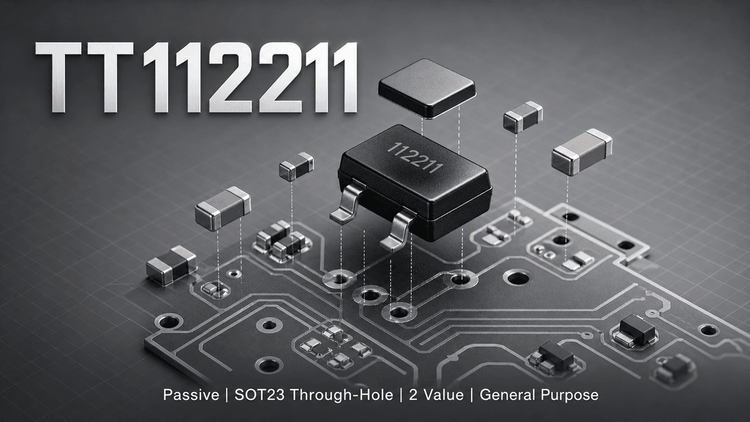
The TT112211 (TI TMP121) is a digital temperature sensor designed for precise thermal management in space-constrained and low-power applications. 💡 Utilizing a SPI-compatible interface with a 12-bit plus sign resolution (0.0625°C), it provides reliable remote temperature sensing without requiring external components. Encapsulated in a tiny SOT23-6 package, this component is ideally suited for power-supply monitoring, battery management systems, and industrial instrumentation where board real estate and power consumption are critical constraints.
🎯 Typical Applications & Design Context
Given its low quiescent current (50µA max) and wide supply range (2.7V to 5.5V), the TT112211 is optimized for energy-efficient designs. 👇 It fits best in scenarios requiring periodic thermal checks rather than continuous high-speed polling.
- Battery Management: Monitoring pack temperature in portable notebooks and cell phones.
- Industrial Control: Extended thermal measurement up to 150°C for motor drives or inverter modules.
- Computer Peripherals: Thermal protection for office machines and hard disk drives.
- Power Supply Modules: Sensing heatsink temps in AC/DC or DC/DC converters.
📊 Key Technical Specifications
| Parameter | Test Condition | Min | Typ | Max | Unit |
|---|---|---|---|---|---|
| Temperature Accuracy | -25°C to +85°C | - | ±0.5 | ±1.5 | °C |
| Supply Voltage | Operating Range | 2.7 | - | 5.5 | V |
| Resolution | Digital Output | - | 0.0625 | - | °C |
| Conversion Time | 12-Bit | 240 | - | 320 | ms |
| Quiescent Current | Serial Bus Inactive | - | 35 | 50 | µA |
| Interface | SPI Compatible | - | - | - | - |
💡 Design Insight: The conversion time (up to 320ms) implies a relatively slow sampling rate. Engineers must ensure the host MCU polling routine accounts for this latency to prevent communication errors or "busy" timeouts during firmware initialization.
⚠️ Absolute Maximum Ratings & Process Limits
Exceeding these ratings causes permanent damage or shifts in calibration accuracy.
| Parameter | Rating | Unit | 🔥 Failure Mode / E-E-A-T Insight |
|---|---|---|---|
| Supply Voltage (V+) | 7.0 | V | Exceeding 7V will likely rupture the gate oxide of the internal CMOS logic, causing catastrophic leakage or dead shorts. |
| Input Voltage | -0.3 to +7.0 | V | Negative voltage (undershoot) on digital pins can forward-bias ESD structures, causing parasitic latch-up. |
| Junction Temp (Tj) | +150 | °C | Operation above 125°C (Spec Range) degrades accuracy. While the device survives to 150°C, data output becomes unreliable. |
| Lead Temp (Soldering) | +300 | °C | Spec assumes manual soldering. For SMT Reflow, strictly follow the thermal profile recommended for SOT23-6 (max 260°C for <40s). |
🔒 SMT Warning: Although rated to 150°C, the plastic SOT23-6 package can suffer moisture-induced cracking ("popcorning") if the MSL (Moisture Sensitivity Level) is not respected prior to reflow. Always bake trays if dry pack is compromised.
🧩 Package, Dimensions & Assembly Notes
- Package Type: SOT23-6 (Surface Mount).
- Marking: "T121" identifies the TMP121 variant.
- Pinout Variation: Note the difference between TMP121 and TMP123 pin configurations (Pin 1 and 2 functions swap). Using a TMP123 footprint for a TT112211 (TMP121) will result in a NC/GND short or V+ misconnection.
- Assembly: The tiny footprint requires careful stencil design. Ensure adequate aperture reduction for the thermal pad (if present on PCB layout) to prevent tombstoning due to uneven wetting forces during reflow.
🔍 Procurement & Sourcing Insights
- Supply Chain Stability: As a mature TI part, availability is generally stable, but lead times can extend unexpectedly due to silicon wafer allocation.
- Alternative Validation: When validating generic equivalents (e.g., from Nuvoton or Maxim), verify the SPI timing format. The TMP121 does not have a register address; it simply streams data. Some alternatives require a command byte first.
- Counterfeit Risk: Low-cost sensors in Huaqiangbei may remark TMP123 as TMP121. Verify the Pin 1 marking orientation against the datasheet diagram to avoid "No Connect" (NC) pin miswiring on the production line.
- Traceability: LDeepAI recommends sourcing via authorized Tier-1 channels or trust-verified franchise distributors to ensure date-code freshness for moisture sensitivity control.
❓ FAQ
Q: Can I replace the TT112211 (TMP121) with a TMP123 directly?
A: No. The pinouts are different. Pin 1 on TMP121 is NC (Not Connected), while Pin 1 on TMP123 is GND. Swapping them without a PCB redesign will short your circuit.
Q: Why does my MCU read incorrect temperature values randomly?
A: Check the CS (Chip Select) timing. The datasheet implies a specific conversion window. If you toggle CS too fast (< 320ms), the sensor may output incomplete conversion data from the previous cycle.
Q: Is the shutdown current low enough for always-on battery systems?
A: Yes. With a shutdown current of 1µA (max), the sleep power draw is negligible compared to self-discharge rates of Li-Ion batteries.
Q: What is the MSL rating for this SOT23-6 package?
A: While the specific MSL isn't in the brief, standard SOT23-6 parts are typically MSL 3 (168 hours floor life). If the packaging is dry-packed, bake before opening if the humidity indicator card (HIC) has turned pink.