📌 Product Overview
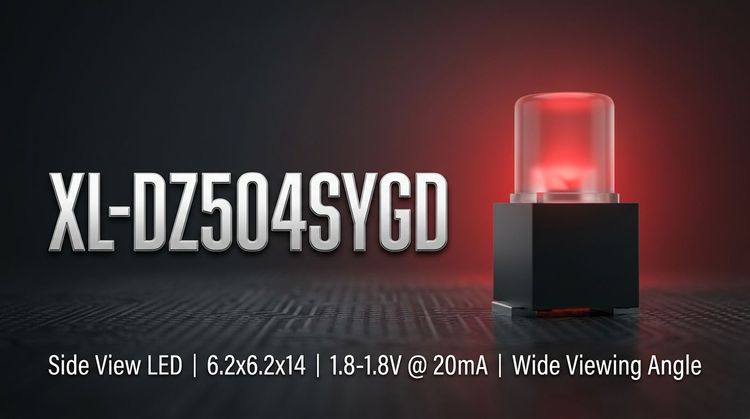
The XINGLIGHT XL-DZ504SYGD is a 2-pin radial LED featuring a yellow-green light source (approx. 570nm) encased in a green colloid package with standard EIA dimensions (6.2x6.2x14mm). Designed for status indication and signal feedback, this component supports low-voltage DC drive systems and offers fast startup characteristics. It is specifically engineered to function as a reliable visual signal in industrial control panels, medical instrumentation, and server storage units.
💡 Design Focus: This component prioritizes long operational life and reduced maintenance costs, making it suitable for dense PCB layouts in IoT and communication devices where consistent visibility is critical.
🏭 Typical Applications
Based on the forward current (20mA) and wide viewing angle (45°), the XL-DZ504SYGD is intended for integration into:
- Status Indicators: Power ON/OFF, network activity, and process status signals.
- Industrial IoT: Human-Machine Interfaces (HMI) and sensor node feedback.
- Medical & Test Equipment: Front panel displays for electronic testing instruments.
- Infrastructure: Storage servers and communication equipment requiring status monitoring.
🚀 Key Utility: Its Low Voltage DC drive capability allows direct interfacing with standard logic circuits without complex driver circuitry.
📊 Key Technical Specifications
Test Condition: Ta=25°C
| Parameter | Symbol | Min | Typ | Max | Unit |
|---|---|---|---|---|---|
| Luminous Intensity | Iv | 50 | - | 200 | mcd |
| Dominant Wavelength | λd | 560 | - | 575 | nm |
| Peak Wavelength | λp | - | 570 | - | nm |
| Forward Voltage | VF | 1.8 | - | 2.4 | V |
| Viewing Angle | 2Ø1/2 | - | 45° | - | deg |
| Reverse Current | IR | - | - | ≤ 5 | μA |
⚠️ Note: Electrical Optical Characteristics are based on IF=20mA. Brightness and voltage binning codes (A1/A2, N12-7/8/9) are available for batch consistency.
⚡ Absolute Maximum Ratings & Process Limits
Ta=25°C
| Parameter | Symbol | Value | Unit |
|---|---|---|---|
| Max Power Dissipation | PD | 50 | mW |
| Max Continuous Forward Current | IF | 20 | mA |
| Peak Forward Current | IFP | 80 | mA |
| Max Reverse Voltage | VR | 5 | V |
| ESD Resistance | ESD | 2000 | V |
| Operating Temperature | TOPR | -40 ~ +85 | °C |
| Storage Temperature | TSTR | -40 ~ +85 | °C |
🔒 Reliability Data: The device supports up to 260°C soldering for ≤6 seconds and has passed 1000h high-temperature/high-humidity endurance testing (Ta=85°C, RH=85%).
📦 Package, Dimensions & Assembly Notes
- Form Factor: Radial Leaded (THT).
- Dimensions: 6.2 x 6.2 x 14 mm (Head x Width x Length).
- Tolerance: ±0.25mm unless specified.
- Packaging: EIA standard packaging in moisture-proof, anti-electrostatic foil bags.
- MSL: Level 2 (must be baked or used within 1 year if sealed bag is opened).
⚠️ Assembly Warning:Static electricity can damage the LED or lower VF. Use grounded tools, ion fans, and anti-static wrist straps. Keep storage environment <30°C and <70% RH.
🏗️ Sourcing & Supply Considerations
- Binning Codes: Specify brightness (A1/A2) and voltage (N12) bins during mass production to ensure display uniformity.
- Authenticity: Verify anti-static packaging markings to avoid counterfeit components in open market supply.
- Lead Time: Confirm stock for specific wavelength codes (HYG01-HYG06) to prevent color shade variations.
- Quality: Compliant with RoHS and environmental protection standards.
❓ FAQ
Q: What is the typical forward voltage drop for this LED?
A: The typical forward voltage (VF) ranges from 1.8V to 2.4V when driven at the rated current of 20mA. Designers should use the N12 voltage grading codes to select tight tolerance batches for consistent power regulation.
Q: Is this LED suitable for high-humidity industrial environments?
A: Yes, the datasheet specifies successful completion of 1000h High Temperature and High Humidity testing (85°C / 85-90% RH). However, for the final assembly, conformal coating is recommended if the device is exposed to harsh condensation.
Q: What are the storage requirements to prevent moisture damage?
A: The LED has a Moisture Sensitivity Level (MSL) of 2. It should be stored at temperatures below 30°C and relative humidity below 70%. If stored beyond 3 months, baking or use of a desiccant cabinet is recommended.
Q: How should I manage the binning for consistent brightness in large panels?
A: You should order specific Brightness Grading Codes (A1: 50-100mcd, A2: 100-200mcd). Mixing these bins will result in visible intensity differences across the user interface panel.