📌 Product Overview
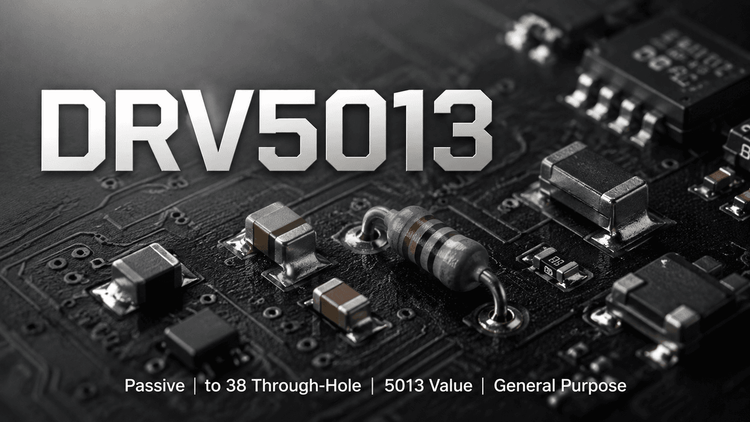
The DRV5013 from Texas Instruments is a chopper-stabilized digital bipolar-latch Hall effect sensor with an open-drain output (30 mA sink capability). It operates from 2.5 V to 38 V with reverse-polarity protection down to –22 V, eliminating the need for an external regulator in most industrial designs.
Available in SOT-23 (DBZ) and TO-92 (LPG/LPE) packages, the DRV5013 targets power tools, flow meters, valve/solenoid status sensing, BLDC motors, and tachometers.
💡 The most critical selection variable is the sensitivity suffix: BOP/BRP options of ±1.3 mT, ±2.7 mT, ±6 mT, and ±12 mT determine which magnetic trigger distance your mechanical design achieves — and it is factory-fixed, not field-adjustable.
🎯 Typical Applications & Design Context
- 🚗 BLDC motor commutation: The bipolar latch retains state between poles, making rotor position tracking stable across the full speed range.
- Power tools: The wide 38 V supply ceiling plus 40 V load-dump tolerance handles battery-pack transients without extra protection circuitry.
- Valve and solenoid status: The latch's hysteresis prevents output chatter near the trip point caused by mechanical vibration.
- Flow meters and tachometers: Fast 35 µs power-on time and chopper stabilization keep duty-cycle readings consistent from –40 to +125°C (up to +150°C for E-grade).
📊 Key Technical Specifications
| Parameter | Value | Engineering Note |
|---|---|---|
| Sensing type | Digital bipolar latch | State retained with field removed |
| Sensitivity options (BOP/BRP) | ±1.3 / ±2.7 / ±6 / ±12 mT | Chosen via part suffix (FA/FD/AD/ND/AG/BC) |
| Supply voltage | 2.5 – 38 V | No external regulator needed |
| BOP drift over temperature | ±10% | Superior stability vs. unchoppered parts |
| Output | Open-drain, 30 mA sink | ⚠️ External pull-up resistor required |
| Power-on time | 35 µs | Enables low-duty-cycle polling |
| Temperature range | –40 to +125°C (Q) / +150°C (E) | Grade selected by suffix |
| Hysteresis (BHYS) | See magnetic characteristics table | Prevents chatter at trip boundary |
👇 Note that ND and FD suffixes have inverted output polarity versus FA/AD/AG/BC — a frequent schematic-migration error.
⚠️ Absolute Maximum Ratings & Process Limits
| Rating | Limit | Consequence if Exceeded |
|---|---|---|
| VCC (forward) | 40 V | Junction damage; automotive load-dump spikes can exceed this without TVS |
| VCC (reverse) | –22 V | Reverse battery hookup survival; beyond this, die failure |
| VCC ramp rate (VCC > 5 V) | ≤ 2 V/µs | 🚨 Fast hot-plug ramps can latch up or damage the device |
| Output pin voltage | 40 V | Overvoltage on pull-up rail destroys output FET |
| Operating junction temp | 150°C (Q) / 175°C (E) | Sustained exceedance causes parametric shift, then latch failure |
| Magnetic flux density | Unlimited | No magnetic saturation damage — safe for strong magnets |
| ESD | HBM ±2.5 kV / CDM ±500 V | Standard handling controls sufficient |
💡 E-E-A-T field note: The most common real-world failure we see is not the sensor itself but the missing 0.01 µF VCC bypass capacitor. On long cable runs (tool triggers, solenoid harnesses), inductive ringing exceeds the 2 V/µs ramp limit and kills units at final test — weeks after SMT, when traceability cost is highest. Also, exceeding the open-drain 30 mA sink limit (e.g., driving an LED directly without a resistor) presents as intermittent output, not hard failure, making root-cause difficult.
🧩 Package, Dimensions & Assembly Notes
| Package | Code | Body Size | Mounting |
|---|---|---|---|
| SOT-23, 3-pin | DBZ | 2.92 mm × 2.37 mm | Surface mount |
| TO-92, 3-pin | LPG / LPE | 4 mm × 3.15 mm | Through-hole |
- DBZ pinout (top view): VCC (1), OUT (2), GND (3). TO-92 pinout differs: VCC (1), GND (2), OUT (3) — 🔒 verify footprints when migrating between packages; pin functions are NOT in the same order.
- Bypass VCC to GND with ≥ 0.01 µF ceramic capacitor rated for full VCC, placed close to the pin.
- Pull-up resistor on OUT must be sized for ≤ 30 mA sink current.
- No MSL concern for these small packages, but TO-92 leads require lead-forming checks for wave-solder or hand-insert processes.
🔍 Procurement & Sourcing Insights
- Suffix discipline: DRV5013 orderable part numbers encode sensitivity + temperature grade + package + tape/reel option (e.g., DRV5013ADQLPG vs. FA variants). A one-letter mismatch changes trip point or polarity — verify the full OPN against your BOM, not just "DRV5013".
- Traceability: TI parts circulate heavily in Huaqiangbei brokering channels; require date-code and lot-code matching, and insist on authorized-distributor or factory-reel packaging for automotive and power-tool programs.
- Sample vs. MP support: Engineering samples are widely available; mass-production volume allocation for E-grade (+150°C) can extend lead times — lock pricing and schedule 12–16 weeks ahead.
- Alternative mapping: Cross-brand latch Hall sensors (e.g., from Melexis, Allegro, Diodes) require matching BOP/BRP, output polarity, and pinout. LDeepAI can provide validated cross-reference and sample validation support.
❓ FAQ
Q: Can I replace a DRV5013FA with DRV5013ND directly?
A: No. ND/FD variants have inverted output logic relative to FA/AD/AG/BC. The schematic pull-up and firmware edge detection must be re-verified.
Q: Why is my DRV5013 output floating?
A: The output is open-drain. A pull-up resistor to your logic rail is mandatory; without it the output never reads high.
Q: What pull-up voltage can I use?
A: Output pin tolerates up to 40 V, so you can pull up to 24 V industrial rails directly and interface with relays or PLC inputs.
Q: Is the DBZ (SOT-23) footprint drop-in compatible with other Hall sensors?
A: The 3-pin SOT-23 footprint is industry-standard, but pin function order varies by vendor. Always verify pin 2/3 assignment before second-sourcing.
Q: How do I verify authenticity of brokered stock?
A: Check TI date/lot codes, order marking code consistency, and request COC. LDeepAI recommends decap-free X-ray and electrical functional screening for non-franchised lots.