📌 Product Overview
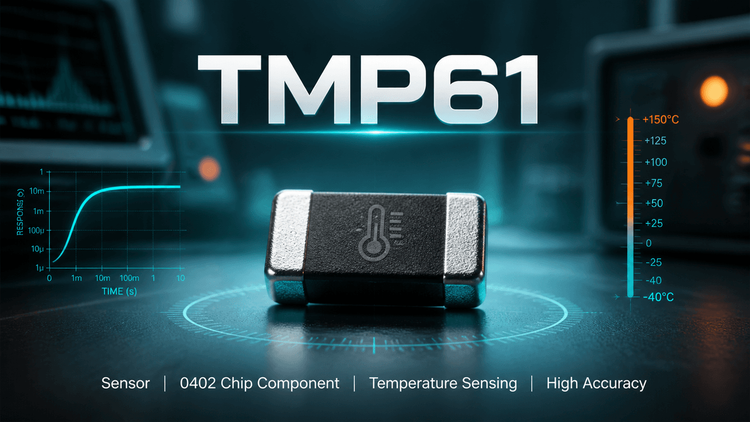
The Texas Instruments TMP61 is a silicon-based Positive Temperature Coefficient (PTC) thermistor featuring a linear resistance-to-temperature response. Unlike traditional NTC thermistors, the TMP61 provides a consistent 10 kΩ nominal resistance at 25°C with a tolerance of ±1% (0°C to 70°C). Designed to simplify circuit design, it eliminates the need for complex linearization algorithms or heavy lookup tables. It is ideal for precision temperature monitoring and thermal compensation in space-constrained applications, offering a robust alternative to discrete NTC/PTC solutions with superior long-term stability.
🎯 Typical Applications & Design Context
Thanks to its linearity and small form factor (down to 0402), the TMP61 is optimized for applications where board space and calculation overhead are critical constraints:
- Industrial & Building Automation: Ideal for HVAC sensors and thermostat controls due to high temperature accuracy and stability.
- Power Supply & Battery Management: Used in chargers and motor control for over-temperature protection (OTP) and thermal threshold detection.
- Consumer Electronics: Effective for display backlight thermal compensation and white goods control, where the low thermal mass allows for fast response times (0.6 s typical).
📊 Key Technical Specifications
💡 Design Note: With a linear output, the conversion logic is simplified compared to the Steinhart-Hart equation required for NTCs.
| Parameter | Specification | Comment |
|---|---|---|
| Sensor Type | PTC Silicon Thermistor | Linear behavior (vs. exponential NTC) |
| Resistance (R25) | 10 kΩ ±1% (max) | Tolerance tightens to ±1% within 0°C to 70°C |
| Temp Coefficient (TCR) | 6400 ppm/°C | Sensitivity at 25°C |
| Temp Range | –40°C to +150°C (Catalog) | Wide range for industrial environments |
| TCR Tolerance | 0.2% typical | Consistent sensitivity across the range |
| Long Term Drift | 0.5% typical | ✨ Key for reliability: Eliminates frequent calibration |
⚠️ Absolute Maximum Ratings & Process Limits
🔒 Mass Production Risk: Strict adherence to bias current limits is mandatory to prevent Self-Heating Errors. Although the datasheet defines functional ranges, exceeding these thermal limits shifts the resistance baseline permanently.
| Parameter | Rating | Failure Mode / Engineering Impact |
|---|---|---|
| Storage Temperature | –65°C to +150°C | Exceeding this can cause package cracking or wire bond damage. |
| Operating Current | Dependent on dissipation | 🚨 Self-Heating: Exceeding bias current causes the sensor to read higher than ambient temperature. |
| Max Power Dissipation | Package dependent (DEC/DYA/LPG) | Thermal shutdown or permanent drift if derating is ignored. |
| ESD Rating | Class 2 (HBM) | Standard handling precautions required during SMT assembly. |
🧩 Package, Dimensions & Assembly Notes
The TMP61 is available in three compact configurations, enabling placement close to heat sources (e.g., CPUs, power transistors) for faster thermal tracking.
- DEC (X1SON, 2-pin): 1.00 mm × 0.60 mm (0402 footprint). Smallest thermal mass.
- DYA (SOT-5X3, 2-pin): 1.60 mm × 0.80 mm (0603 footprint).
- LPG (TO-92S): 4.00 mm × 1.52 mm. Through-hole option for prototyping or non-SMT applications.
SMT Validation Guide:
- Pad Design: Use standard land patterns for 0402/0603. Ensure thermally conductive paste if PCB is heatsinked.
- Placement: Do not place near high-velocity air vents or turbulent exhaust fans, as this creates localized cooling errors unrelated to component temperature.
🔍 Procurement & Sourcing Insights
For procurement teams, the TMP61 offers supply chain stability compared to specialized NTCs, but specific attention is needed:
- Grade Selection: The catalog version supports up to 150°C. For automotive or higher reliability needs, the TMP61-Q1 (Automotive Grade) is required, supporting up to 170°C with AEC-Q100 qualification.
- Package Availability: The DEC (0402) package is highly popular in high-volume consumer electronics. Check lead times for specific packaging codes, as the X1SON may have longer lead times than the SOT-5X3 variant.
- Alternative Validation: When sourcing from distribution or Huaqiangbei channels, verify the TCR (Temperature Coefficient of Resistance). Generic thermistors may fit the footprint but deviate in linearity, requiring firmware rewrites.
❓ FAQ
Q: Can I replace an NTC thermistor with the TMP61 without changing the circuit?
A: 🚫 Physically maybe, electrically no. The TMP61 is a PTC (resistance increases with temperature), while most standard thermistors are NTC (resistance decreases). You must update your firmware scaling (lookup table) and potentially change the voltage divider topology to utilize the linear response correctly.
Q: What is the main advantage of the TMP61 over a standard NTC?
A: The primary advantage is Linearity and Consistency. Unlike NTCs, the TMP61 has a consistent sensitivity (6400 ppm/°C) across the temperature range. This eliminates the need for complex beta calculations or large lookup tables, reducing MCU processing time and memory usage.
Q: How does the "Fail-Safe" behavior work in this sensor?
A: The TMP61 acts as a PTC. If the sensor experiences a short-circuit failure, the resistance drops effectively to zero. Your system firmware can detect this abnormally low resistance as a fault code (e.g., "Sensor Short"), allowing the system to shut down safely rather than running with incorrect temperature data.
Q: Is the TMP61 suitable for measuring liquid temperatures?
A: Yes, provided it is isolated from the liquid (e.g., on the backside of a PCB or inside a sealed probe). The X1SON (0402) package is excellent for this due to its low thermal mass, but it must be protected from direct moisture/condensation which could bridge the pins or corrode the package.